
Field notes
Price Testing on Shopify: Methods That Keep Customer Trust
August 5, 2026

A skincare brand doing roughly $8M a year takes its hero serum from $42 to $46 in a split test. Conversion rate on the product page falls about six percent. Revenue per session rises. The dashboard says ship it. Three weeks later someone posts two screenshots side by side in a 40,000-member Facebook group, both taken the same afternoon, both showing the same SKU at different prices. The comment thread is not about elasticity.
That is the actual risk profile of price testing on Shopify, and it is not the one most testing guides describe. The statistical problems are solvable and well documented. The trust problem is the one that ends programs, and in the last eighteen months it stopped being purely reputational: New York's Algorithmic Pricing Disclosure Act took effect on 10 November 2025, and the FTC's surveillance pricing study is still open.
The good news is that the trust risk lives in a narrow band of testing methods. Most of the margin available to a $2M to $20M brand sits outside that band entirely.
TL;DR
- Price is the highest-leverage line in your P&L and the one most brands change by gut. McKinsey's long-running estimate is that a one percent price increase at stable volume produces roughly eight percent more operating profit for an average S&P 1500 company.
- Shopify's native testing feature, Rollouts, cannot test price. It splits theme versions only. Every real price test needs an app or a sequential design.
- Trust breaks on three specific mechanisms: simultaneous visible price differences, identity-based pricing, and retroactive regret. Randomized session-level tests with a price-protection rule avoid all three.
- The legal floor moved in 2025. Setting a price from personal data now carries a disclosure requirement in New York and federal scrutiny elsewhere.
- Test price architecture before you test price points. Thresholds, bundles and tier gaps are safer, faster and usually worth more.
Why the price line is worth the discomfort
Run the arithmetic on a brand with a 65 percent gross margin selling at $42. Contribution margin per unit is $27.30 before variable marketing. Move to $46 and contribution is $31.30, a 14.7 percent increase per unit. You can lose 12.8 percent of your unit volume and still be flat on contribution dollars. Most operators, asked to guess that breakeven volume drop, guess something closer to five percent. The asymmetry is why price is worth testing properly rather than adjusting once a year in a spreadsheet.
The same asymmetry works against you downward. Discounting five percent off that $42 requires a 22.6 percent volume increase just to hold contribution flat. This is the same shape as the break-even ROAS math most brands already run on paid media, applied to the other side of the equation.
That is the prize. The rest of this article is about collecting it without the screenshot thread.
The three mechanisms that actually break trust
Fairness perception in pricing is not a vague sentiment. Research published in International Journal of Market Research in 2025 found that personalized pricing reduces perceived fairness regardless of whether the customer personally benefits from it, operating through suspicion of seller motives and negative moral emotions rather than through economic outcome. Customers who got the lower price still rated the practice as unfair. That finding matters because it kills the usual defense that no one was harmed.
Three concrete mechanisms carry the damage.
Simultaneous visibility. Two people can compare prices in real time. Group chats, Reddit threads, and Facebook communities make your test variants collide. The risk scales with community density, not with traffic volume, which is why tightly networked categories (supplements, hobby gear, fandom merchandise) are the worst place to run a naive price test and general household goods are among the safest.
Identity as the input. A price that changes because of who you are reads as extraction. A price that changes because of when you bought or what you bought together reads as commerce. This distinction is now legally load-bearing, not just rhetorical.
Retroactive regret. The customer who paid $46 on Tuesday and sees $42 on Friday feels cheated even though nothing about their transaction changed. This is the mechanism a price-protection rule neutralizes, and it is the cheapest insurance in the whole exercise.
The 2025 regulatory shift you cannot ignore
Three things happened in quick succession, and all three are now live constraints on how you design tests.
The FTC published preliminary findings from its 6(b) surveillance pricing study in January 2025, documenting that intermediaries use location, browser history, cart contents and even mouse movements to set individualized prices and target promotions. The study is descriptive rather than an enforcement action, but it built the record everything since has cited.
New York then enacted the first statute of its kind. Since 10 November 2025, a business using algorithmic pricing based on consumers' personal data must display the line "THIS PRICE WAS SET BY AN ALGORITHM USING YOUR PERSONAL DATA" clearly and contemporaneously with the offer, with civil penalties up to $1,000 per violation. The law survived a First Amendment challenge. Subscription pricing that offers existing customers a lower rate is carved out.
California moved on a different axis. AB 325 amended the Cartwright Act effective 1 January 2026 to address common pricing algorithms used in restraint of trade, and the state attorney general has run a sweep on whether companies use personal data to set individualized prices.
If you want a preview of the reputational side, look at what happened to Delta in mid-2025. Three US senators wrote to the CEO objecting to fares "tailored to an individual consumer's willingness to pay," and Delta ultimately issued a public statement that it does not and will not use individualized prices based on personal data. The airline's actual system was a market-level dynamic pricing tool. The distinction did not survive the news cycle. Yours will not either.
The practical rule this produces is simple. Personal data is not a permitted input to price. Session randomization, geography, channel and time are.
What Shopify actually lets you do
Shopify shipped native A/B testing as Rollouts in the Winter '26 Edition, and it is genuinely useful: server-side traffic splitting between theme versions with no flicker, ramping from 10 percent to 100 percent, no app and no extra fee on Grow and above. It also has no pricing layer, does not touch checkout, does not support Liquid template edits, and does not report statistical significance. For price work it is the wrong tool, full stop.
That leaves four real mechanisms on the platform.
| Mechanism | How it works | Trust risk | Main limitation |
|---|---|---|---|
| Session-split app | App overrides displayed price and applies a matching discount at checkout | Low to medium | Price must stay consistent across PDP, cart, checkout and BNPL widgets or you get a bait-and-switch complaint |
| Duplicate variants or products | Second SKU at a different price, traffic split by redirect | Medium | Catalog pollution, duplicate URLs, broken inventory sync, and it distorts your product feed and SEO |
| Sequential (time-based) | Old price for four weeks, new price for four weeks | Very low | Confounded by seasonality, promo calendar and ad spend changes. Needs a control channel |
| Markets and B2B catalogs | Country-level price adjustments, or per-company price lists | Very low | Legitimate segment pricing rather than a test. Requires Shopify Payments and a country selector |
The sequential design is underrated. It carries almost no fairness exposure because no two shoppers see different prices at the same moment, and for a brand with a stable promo calendar and steady media spend it is often cleaner than operators assume. It fails badly in Q4 and during launches. It is excellent in February.
Tools, costs, and when each one is wrong
| Tool | Listed cost | Price testing | When it is the wrong choice |
|---|---|---|---|
| Shopify Rollouts | Included, Grow plan and above | No | Any pricing, checkout or Liquid-level test. No significance reporting |
| Intelligems | $69 to $349 per month by module, scales with order volume | Yes, purpose-built | Overkill if you have fewer than roughly 1,000 orders a month. You will not reach power on any single test |
| Shoplift | $99 Core, $399 Advanced, $999 Pro | Beta, Advanced plan and up | If price is the primary use case. You are paying $399 for a beta layer on a CRO tool |
| Split | Free tier, $10 per month premium | Yes | Anything load-bearing. 2.8 stars across 13 reviews, with reported conflicts against third-party apps |
| Manual sequential | Analyst time only | Yes, by calendar | Seasonal categories, launch periods, or any month where media spend is changing |
Two notes on tool selection that the vendor pages will not tell you.
First, cost is not the constraint. Analyst time is. A price test that nobody reads correctly is worse than no test, because it produces a confident wrong decision. If you cannot allocate someone to hold the test open for four weeks and read contribution margin rather than conversion rate, buy nothing.
Second, traffic is the real gate. Price tests need more traffic than layout tests because the effect you care about is a product of two moving numbers. Work the sample size math before you subscribe to anything, and if the answer is eleven weeks, run sequential instead.
Read contribution margin, not conversion rate
Every price test dashboard defaults to conversion rate. Conversion rate is the wrong metric here, and it is wrong in a predictable direction: higher prices always look bad on it.
The metric is contribution margin per session. Price times gross margin percent times conversion rate, less variable fulfillment and payment costs, divided by sessions. Build it once in your finance dashboard and stop reading anything else during a price test.
Three second-order effects the dashboard will not show you.
Return rate moves with price. Higher prices attract more considered purchases and often reduce return rate, which flatters the winning variant in ways the app does not capture. Check returns by cohort before you finalize. Your returns policy interacts with this.
Repeat rate moves too, and it moves late. A price increase that looks flat on first-order contribution can be materially negative at 180 days if it shifts your acquired mix toward one-time buyers. This is a lifetime value question, and it means a price decision made on four weeks of data is provisional, not final.
Free shipping thresholds interact with everything. Extra costs at checkout remain the single largest stated reason for abandonment, cited by 40 percent of US shoppers in Baymard's research. Raising unit price while holding a $50 free shipping threshold quietly changes the number of units required to clear it, which changes AOV, which changes your read. Test one at a time or model the interaction explicitly. Our checkout friction audit covers the mechanics.
Our take
Most brands in the $2M to $20M range should not be testing unit price points at all this year. They should be testing price architecture.
The reasoning is mechanical, not aesthetic. A unit price test on a single hero SKU asks one narrow question, needs weeks of traffic to answer, carries the entire fairness risk surface, and delivers a single number that decays as your cost base and competitive set move. A price architecture test asks a structurally richer question, runs entirely in public, and compounds.
Architecture means the free shipping threshold, the bundle construction, the subscription discount depth, the tier gaps in your loyalty program, and the good-better-best spread across your range. All of these change effective realized price per customer. None of them require two shoppers to see different numbers for the same SKU at the same moment. All of them are visible, explicable and defensible if a customer asks.
We will also disagree with the standard advice on willingness-to-pay surveys. Van Westendorp price sensitivity studies are cheap and popular, and they are a weak input for an existing catalog. The method is hypothetical, ignores product features entirely, and does not account for competitors, demand curves or elasticity. Research comparing it to incentive-aligned methods finds it can approximate an optimal price point, but any result needs validation against real sales data before you act on it. For a brand that already has transaction history, your own historical promo depths and price changes are a better elasticity dataset than a survey panel, and you already own them.
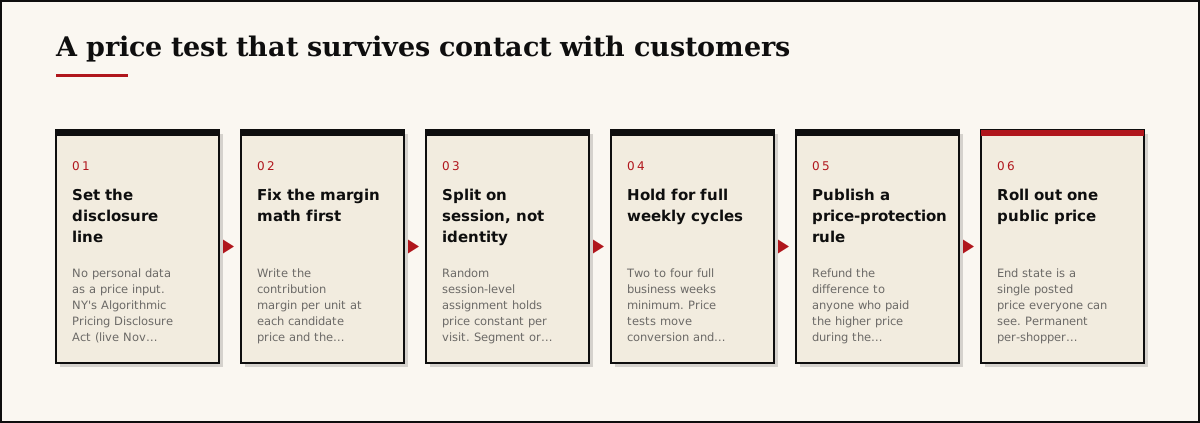
Where we do think unit price testing earns its keep: new SKUs with no price history, categories with genuinely unknown reference prices, and any brand whose COGS has moved more than ten percent since the current price was set. In those three cases, run it properly with the sequence in the diagram above.
One more position. Publish your price-protection rule before you start, not after someone complains. Something short in your FAQ: if the price of an item drops within 30 days of your order, contact us and we will refund the difference. It costs a rounding error, it removes the retroactive regret mechanism entirely, and it converts a discovered test from a betrayal into an administrative task. Brands that have this rule can test far more aggressively than brands that do not, which is the opposite of how most operators think about it.
What to do this week
- Calculate the breakeven volume drop for a five percent price increase on your top three SKUs. If you cannot state it from memory, you are not ready to test anything.
- Write your price-protection rule into your FAQ and order confirmation email today, before any test exists.
- Audit your inputs: confirm no app, script or personalization layer is currently setting price or discount eligibility from customer-level personal data.
- Pick one architecture test (threshold, bundle, or subscription discount depth) and scope it for a four-week run instead of a unit price test.
- Build contribution margin per session as a saved view so the price conversation stops being a conversion rate conversation.
Pricing is where a growth retainer either pays for itself several times over or quietly does nothing, and the difference is usually whether anyone is willing to hold a test open long enough to read it honestly. If you want a second set of eyes on your margin structure, your test design, or whether your current stack is setting prices from data it should not touch, book a 30-minute call. If you would rather see the gaps first, start with a free audit, or send us your requirements for a custom quote.
Frequently asked questions
No. Shopify Rollouts, the native testing feature shipped in the Winter '26 Edition, splits traffic between theme versions only. It has no pricing layer, does not touch checkout, and does not support Liquid template edits. Any real price test on Shopify needs a third-party app or a time-based sequential design.
Showing different prices to different randomly assigned sessions is generally lawful in the US. Setting a price from an individual's personal data is now regulated. New York requires a conspicuous disclosure on such prices as of November 2025, and the FTC has an open 6(b) study on surveillance pricing. Take legal advice for your states.
Two to four full business weeks at minimum, and never fewer than two complete weekly cycles. Price changes push conversion rate and average order value in opposite directions, so the net effect on contribution margin per session stabilizes much later than a conversion-only test.
Architecture first for most brands. Bundle construction, free shipping thresholds, subscription discount depth and tier gaps are tested in the open, carry almost no fairness risk, and usually move contribution margin further than a five percent change to a single unit price.
Refund the difference immediately and without argument, then say the test is running and when it ends. Publish that price-protection rule before the test starts. A discovered test with a standing refund rule is an administrative event. A discovered test without one is a screenshot.
Entry-level apps start near $10 to $99 per month. Intelligems lists module plans from $69 per month up to $349 per month on the Shopify App Store, scaling with order volume. Shoplift gates price testing to its Advanced plan at $399 per month. Budget for analyst time as well as license cost.
One-page resource
Get the Small Store Revenue Checklist.
The 12 things that actually move revenue on a store under $50K a month, in the order we'd fix them. Delivered to your inbox.