
Field notes
AI in D2C Operations: Where It Works and Wastes Money
August 4, 2026

A $7M supplements brand runs an audit of its software line. Over eighteen months it has added an AI writing tool for product copy, a conversational onsite assistant, a creative generator plugged into its ad account, an AI layer on its helpdesk, and a seat on an analytics platform bought largely because it had a chat interface. Combined, about $2,100 a month.
The only one anybody can defend with a number is the helpdesk. Support tickets that resolve without a human are billed per resolution, and the finance lead can compare that unit cost against a loaded agent hour. Every other line is defended with a story: it saves time, the team likes it, everyone else has one.
That is the actual state of AI in mid-market D2C in 2026. Not a technology problem. A measurement and workflow problem, and it is expensive precisely because each individual line item is small enough to survive a budget review.
TL;DR
- Adoption is near-universal and impact is not. McKinsey found only about 6% of organizations qualify as AI high performers attributing 5%+ EBIT impact, and workflow redesign is the single strongest predictor of getting there.
- The AI spend that pays back in D2C is priced per unit of output (per resolution, per forecast cycle), not per seat.
- The highest-leverage 2026 move is unglamorous: clean, structured, machine-readable product data. AI-referred retail traffic now converts 42% better than non-AI traffic, and it reads your catalog, not your homepage design.
- The reliable money pits are onsite AI shopping assistants, generative creative volume without a testing structure, and custom internal agents built on data that was never modeled.
- If a tool cannot name the metric it moves and the person who owns it, cancel it this quarter.
The 2026 baseline: everyone has adopted, almost nobody has scaled
McKinsey's State of AI survey, fielded across 1,993 respondents in 105 countries, puts the gap plainly. Adoption is broad, but only around 6% of organizations qualify as AI high performers, defined as attributing 5% or more of EBIT to AI use. The differentiator is not model choice or budget. It is the deliberate redesign of workflows, which McKinsey identifies as having one of the strongest contributions to business impact of every factor tested.
The widely circulated MIT Project NANDA report reached the same conclusion from the other direction, reporting that 95% of enterprise generative AI pilots produced no measurable P&L impact and attributing the failure to approach rather than technology. Treat the exact figure with some caution, since the sample is small and the methodology has been contested. Treat the direction as correct, because it matches what you see in any D2C software audit.
The mechanism matters more than the statistic. A tool bolted onto an unchanged process gives you the same process, slightly faster, at a higher cost. The process was the constraint.
Sorting the stack by effort and evidence
Before buying anything, place each candidate on two axes: how much operational effort it takes to deploy properly, and how strong the evidence is that it moves a real number in your business.
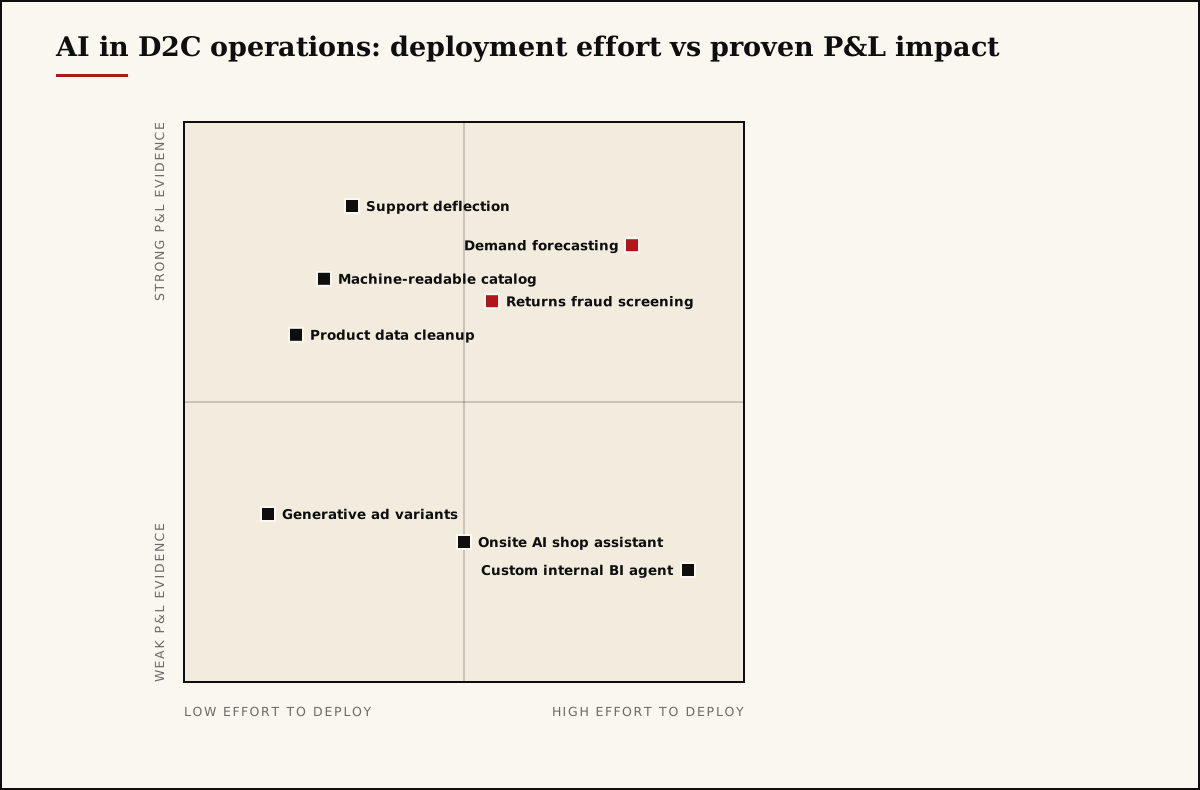
The top-left quadrant is where you start. The bottom-left is where most brands actually start, because those tools are cheap and demo well. The bottom-right is where budgets go to die.
The unit economics test
The single most useful filter is pricing model. Tools priced per unit of output force a comparison against the human cost of that same output. Tools priced per seat do not.
Gorgias publishes its AI Agent at $0.90 per fully resolved conversation on most plans and $1.00 on Starter, and does not double-charge when the AI hands off to a human. That is a number you can put next to your loaded cost per ticket and get a defensible answer in an afternoon. Whether the answer is yes depends on your ticket mix, but at least the question is answerable. We covered the deployment mechanics in AI customer support for D2C brands, so this piece will not repeat that ground.
Compare that to a $200 monthly seat on an analytics platform because it added a chat interface. There is no unit of output to price. The tool becomes unfalsifiable, and unfalsifiable tools never get cancelled.
Apply the test before purchase. If you cannot express the tool's value as cost per unit of work displaced, you are buying a feeling.
Tools worth naming, and when each is the wrong choice
| Tool | Published price | Buy it when | Wrong choice when |
|---|---|---|---|
| Gorgias AI Agent | $0.90-$1.00 per resolution | Ticket volume is above roughly 800/month and half is order status, WISMO and returns initiation | Your help center is thin. Ungrounded answers invent policies you then have to honor |
| Shopify Sidekick | Included with the plan | You want bulk edits, segment building and reporting without waiting on a developer | You need it to replace analytical judgement rather than execute a defined change |
| Klaviyo Composer / Customer Agent | Credit-based, layered on the contact plan | Your flow library is already built and you want faster campaign iteration on top of it | Your flow foundations are missing. Agents accelerate whatever structure exists, including a bad one |
| Cogsy | Published at $199/month | You are a single-brand D2C operation with real reorder decisions and no planner on staff | SKU count is under about 30 and a spreadsheet with lead times still works |
| Inventory Planner | Quote-based, scales with inventory volume | Multi-warehouse, multi-channel, and forecast error is costing you markdowns | You want a price on a web page. Quote-only pricing means a sales cycle |
| Triple Whale | Free tier, then tiered by annual GMV | You already run on MER-led measurement and want the reporting consolidated | You are buying it for the AI assistant. The value is the data model, not the chat box |
Two patterns to notice. Every tool with a defensible ROI story attaches to a workflow that already existed and was already measured. And every quote-based vendor is telling you that your deployment is a project, not a purchase.
The four ways the money actually leaks
Buying capability instead of replacing a step. The tool gets added alongside the existing process. Nobody removes the human step it was supposed to displace, because removing it requires a decision somebody has to own. Cost goes up, output stays flat. This is the failure mode McKinsey's workflow-redesign finding is describing.
Volume without a testing structure. Generative creative makes producing forty ad variants trivial. It does not make evaluating forty variants trivial, and forty variants across a small budget guarantees none of them reaches statistical usefulness. Read creative refresh cadence for Meta alongside this. Production capacity was never the binding constraint on creative performance. Learning rate was.
Automating a process that should be deleted. Plenty of D2C operational work exists because of an earlier bad decision: a returns policy that generates disputes, a variant structure that generates the wrong SKU being shipped, a subscription cadence that generates skip requests. Automating those handoffs makes the underlying defect cheaper to tolerate, which means it never gets fixed.
Custom builds at the wrong revenue band. A custom agent over your own data requires a warehouse, modeled definitions, an evaluation harness and someone to maintain all three. At $2M-$20M that is a data engineering program disguised as an AI project. Build it when you have a data function. Buy until then.
The surface that genuinely changed: your store is now read by machines
This is the part of the 2026 picture that is actually new, and most operators are underweight on it.
Adobe Analytics, working from over a trillion visits to US retail sites, reported that AI-referred traffic to US retailers rose 393% in Q1 2026 year over year. The quality shift is more interesting than the volume. In March 2026 AI-sourced traffic converted 42% better than non-AI traffic, produced 37% higher revenue per visit, spent 48% longer on site and viewed 13% more pages. In March 2025, the same measurement had AI traffic converting 38% worse.
That reversal is the signal. A year ago AI referrals were curiosity traffic. Now they arrive pre-qualified, because the model has already done the comparison work using whatever structured data it could reach.
At the same time the checkout layer is unsettled. Stripe and OpenAI published the Agentic Commerce Protocol as an open standard, and competing rails from Visa, Mastercard and a Google-led coalition are all in flight. Do not spend engineering budget picking a winner. Spend it on the layer every one of those rails depends on: accurate, complete, structured product data with correct pricing, availability, variants, dimensions, materials and policies.
That is also the one place generative AI has clear operational leverage on the catalog, provided you use it to fill and normalize structured attributes rather than to mass-produce prose. Google's own guidance permits generative AI content that adds value while explicitly naming scaled content abuse, generating many pages without adding value for users, as a violation. Merchant Center goes further and asks that AI-generated titles and descriptions be specified separately and labeled as AI-generated. Attribute completion is safe and valuable. Ten thousand pages of synthetic copy is not.
If your product detail pages and feeds are thin, no agentic rail will help you, because there is nothing for the agent to reason over.
Returns: where AI earns its cost quietly
Returns are the least glamorous and most defensible AI application in D2C right now. The NRF and Happy Returns 2025 landscape put online return rates at 19.3% against $849.9 billion of total returned merchandise, with 9% of all returns assessed as fraudulent.
Two AI-shaped jobs sit inside that. Pattern detection on serial returners and wardrobing, which is a classification problem with plenty of labeled history, and reason-code analysis, which turns free-text return reasons into structured signals about sizing, imagery and description accuracy. The second one feeds directly back into the catalog work above, which is what makes it compound. Pair this with the operational controls in our returns fraud prevention guide.
Neither of these is a chat interface. Both are unglamorous classification running on data you already own. That is the profile of AI work that survives a budget review.
Our take
Most D2C brands in this revenue band should reduce their AI tool count in 2026, not increase it.
The reasoning is about where the constraint actually sits. At $2M-$20M with a team of five to twenty-five, your binding constraint is not the speed at which work gets produced. It is the number of decisions the leadership team can carry properly at once. Every tool added consumes some of that budget: it needs an owner, a metric, an integration, a review cadence. Adding six tools that each save two hours a week, while adding six things nobody owns, is a net loss. This is the same argument we make for growth retainers over one-off projects, and it applies to software just as hard.
The conventional advice, run lots of small experiments and see what sticks, is wrong at this size. It is advice designed for organizations with slack capacity to absorb failed experiments. You do not have that. Two AI deployments, fully integrated, with the human step actually removed and a named owner on each, will beat eight pilots every time. This is the practical form of McKinsey's workflow-redesign finding: depth beats breadth when your organizational bandwidth is the scarce resource.
We would also argue the market has the priority order backwards. The attention goes to the customer-facing layer, chat assistants and generated copy, because it is visible and demos well. The returns are in the layers customers never see: forecasting, returns classification, catalog structure, ticket deflection. Boring, measurable, compounding. If your AI roadmap is mostly things a customer would notice, it is probably a marketing roadmap with an AI label on it.
One prediction we will commit to. Within eighteen months the meaningful competitive difference will not be which model a brand uses. It will be whether the brand's product data is complete and structured enough for machines to reason over. That work is available today, costs almost nothing in software, and almost nobody is doing it.
What to do this week
- Export every software line item and mark each one with the metric it moves and the person who owns it. Cancel anything with a blank in either column.
- Price your top AI candidate per unit of output and compare it to the loaded human cost of that same unit. If you cannot compute it, do not buy it.
- Audit one collection's product data for attribute completeness: variants, dimensions, materials, availability, policy fields. Extrapolate the gap across the catalog and size the fix.
- Pull ninety days of return reason codes and classify them into sizing, imagery, description and quality buckets. Fix the largest bucket at source.
- Pick one workflow where you will actually remove the human step, name the owner, and set a review date sixty days out.
If you want an outside read on which parts of your stack are earning their cost and which are quietly leaking, book a call and we will go through it with you. Bring the software line and ninety days of ticket and return data. If you already know the scope of the work you want done, request a custom quote instead, or start with a free audit if you would rather see the findings before you talk to anyone.
Frequently asked questions
Look at incremental spend, not total stack cost. Most brands at that size can cover support automation, forecasting and catalog tooling for roughly $500 to $1,500 a month above what they already pay. Anything beyond that needs a named owner and a metric it is supposed to move.
Usually not first. It touches a small share of sessions, it is hard to measure cleanly against a holdout, and it competes with your existing merchandising. Fix product data and support deflection before you add a conversational layer on top of a catalog that is still thin.
Not inherently. Google permits generative AI content that adds value and penalizes scaled content abuse, meaning many pages produced without adding value. Google Merchant Center also asks that AI-generated titles and descriptions be specified separately and labeled as AI-generated.
Rarely at this revenue band. A custom agent needs a warehouse, clean definitions, evaluation and ongoing maintenance. That is a data engineering project wearing an AI costume. Buy the tool that already solved the workflow and spend the saved time on merchandising.
Define the metric before you buy, hold out a slice where you can, and measure the workflow end to end. Automated resolution rate means nothing if repeat contacts rise. Forecast accuracy means nothing if stockouts and markdowns do not both improve.
The volume is still small in absolute terms but the quality is high. Adobe measured AI-referred retail traffic converting 42% better than non-AI traffic in March 2026, having converted worse a year earlier. Make your catalog machine-readable now, before it becomes a competitive scramble.
One-page resource
Get the Small Store Revenue Checklist.
The 12 things that actually move revenue on a store under $50K a month, in the order we'd fix them. Delivered to your inbox.