
Field notes
Loyalty vs Subscription: Which Retention Fits Your Margin
August 5, 2026

A skincare brand doing about $8M a year asked us to spec a loyalty program. They had the vendor shortlist ready, the tier names picked, and a launch date. Two questions in, the real situation surfaced. They already ran subscribe-and-save at 20 percent off. Their contribution margin after shipping, payment fees and the subscription discount was around 28 percent. The proposed loyalty program would issue points worth roughly 5 percent of order value, redeemable on any order, including subscription orders.
That is a 25 percent blended discount on the customers who need the least persuasion, funded out of a 28 point margin, with a new $199 a month app on top. The program would have worked exactly as designed and made the business worse.
This is the most common retention mistake we see at the $2M to $20M band. Operators treat loyalty and subscription as two flavors of the same thing, pick whichever the last podcast recommended, and end up running both badly. They are not the same thing. They solve different problems, they fail in different ways, and the deciding variable is not category fashion. It is your gross margin and how predictable your reorder interval is.
TL;DR
- Subscription buys predictability and pays for it in gross margin. Loyalty buys frequency and pays for it in deferred liability and merchandising complexity.
- Pick on two axes: contribution margin after shipping and fees, and how clockwork your natural reorder interval is. Products with a real consumption clock want subscription. Products bought on occasion want loyalty.
- Running both is defensible. Running both at full discount is not. The blended discount on your best customers is the number to govern.
- Subscription platforms cost roughly $99 to $599 a month plus about 1 percent of subscription GMV. Loyalty apps run free to $999 a month. Neither line item is where the money goes.
- Involuntary churn is roughly a third of all subscription churn in this category, per Recurly's benchmark data. Fixing dunning is cheaper than any new mechanic.
The two mechanics are answers to different questions
Subscription answers: how do I stop the customer having to decide again? It converts a repeated purchase decision into a single decision plus an ongoing default. The value you capture is scheduling. You know the unit will ship, so you can forecast inventory, negotiate freight, and underwrite acquisition against a known number of shipments rather than a hopeful LTV.
Loyalty answers: how do I make the next discretionary decision tilt my way? There is no schedule to capture, because the customer genuinely does not need another jacket on a fixed interval. So you build a small switching cost, an accumulated balance and a status position, and you accept that the effect is probabilistic.
That difference explains the cost structures. Subscription costs are immediate and certain: you give the discount on every order, forever, whether or not the customer would have reordered anyway. Loyalty costs are deferred and uncertain: you issue a liability now and pay it later, if the customer redeems. Antavo's 2026 report found about 27 percent of earned points went unused in 2025, and among programs with expiry, about 12 percent of points earned expired (Antavo Global Customer Loyalty Report 2026).
Do not read that breakage as free money. Read it as a modeling problem. Unredeemed points are the part of your program that produced no behavior change and no cost. The redeemed portion is where both the behavior and the bill live.
The decision is margin and cadence, not category
Two inputs decide this, and both are on your P&L already.
Contribution margin after shipping, payment fees and the discount you are contemplating. Not gross margin from the catalog. The real number that funds pick, pack, support and returns.
Reorder cadence predictability. Not average days between orders. The variance around it. A supplement customer running out on day 30 has a clock. An apparel customer buys when something wears out, when the season turns, or when your creative catches them. Averaging those into "buys every 94 days" produces a number you cannot schedule against.
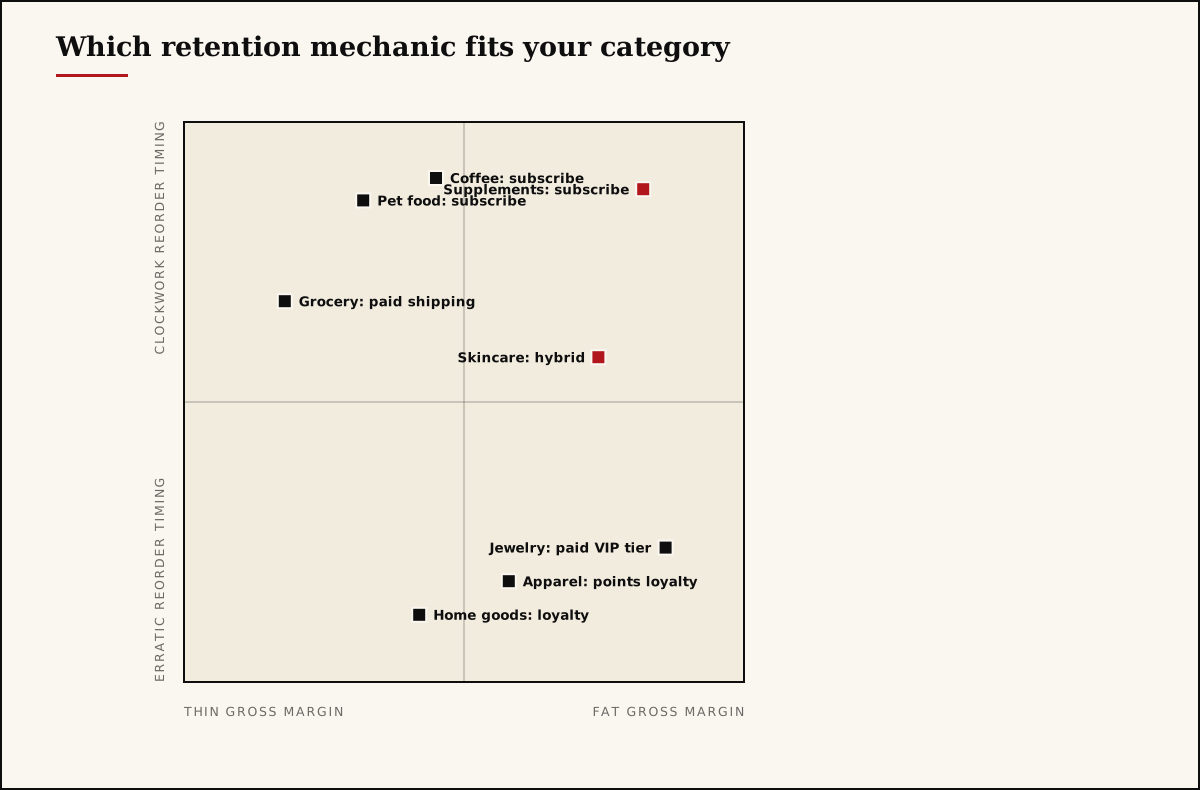
The top of that matrix is subscription territory regardless of margin, because a real consumption clock is the rarest asset in retention and you should monetize it when you have one. The bottom is loyalty territory regardless of margin, because there is no schedule to sell. Margin decides the shape within each half: thin margin plus a clock points to paid shipping membership rather than a percentage-off subscription, and fat margin plus no clock points to a paid VIP tier rather than a points ladder.
What each mechanic actually costs to run
Software is the smallest line. Here is what the market charges as of August 2026.
| Tool | Type | Entry cost | Variable cost | When it is the wrong choice |
|---|---|---|---|---|
| Recharge | Subscription | $99/mo Starter, $499/mo Plus | 1.49% + 19c per transaction (Starter), 1.34% + 19c (Plus) | If your only need is a simple selling plan and Shopify native subscriptions cover it |
| Skio | Subscription | $499/mo billed annually, $599/mo monthly | 1% + 20c on subscription orders | Sub-$2M subscription GMV, where the fixed fee dominates |
| Loop | Subscription | Free under 50 active subs, $99/mo Starter, $399/mo Pro | 1.0% Starter, 0.75% Pro | Complex bundles and prepaid plans that outgrow the Pro feature set |
| Stay AI | Subscription | $499/mo Pro | 1% + 19c per transaction | Small subscriber bases where the churn tooling has nothing to work on yet |
| Smile.io | Loyalty | Free to 200 orders/mo, $199/mo Growth | Order-volume tiers | You need deep tier logic or a custom earning model; VIP sits on Growth and above |
| LoyaltyLion | Loyalty | Free under 400 orders/mo, $199/mo Classic (500 orders) | Order-volume tiers, custom above Classic | Low order counts where the fixed fee exceeds the incremental margin |
Note the shape difference. Subscription pricing is percentage-of-GMV, so it scales with the thing it manages and never surprises you. Loyalty pricing is order-band, so it steps. A brand crossing an order threshold can see the app bill jump while program performance sits flat.
The real cost is elsewhere. For subscription it is churn work: onboarding, cadence correction, failed payment recovery, support tickets about skips. Recurly's July 2026 benchmarks put ecommerce and subscription-box churn at 4.25 percent monthly, split 2.87 percent voluntary and 1.38 percent involuntary. Roughly a third of your churn is payment failure, not dissatisfaction. That is an operations problem with a known fix, covered in our dunning recovery flow guide.
For loyalty the real cost is merchandising discipline. Every promotion has to be checked against point earning and redemption, or you ship 40 percent off weekends to people already sitting on a 15 percent balance.
The evidence for each, read honestly
Recharge's 2026 Subscription Trend Report, drawn from about 20,000 brands, reports subscribers placing nearly three times as many orders as one-time shoppers, subscription checkouts up 16 percent, and same-day cancels down 35 percent. It also reports brands increasing first-order discounts by 18 percent, which is the part most summaries skip. Frequency is being bought.
On the loyalty side, Growave's State of Loyalty 2025, covering more than 100 Shopify brands, found redeemers hitting a 65 percent repeat purchase rate against 12.3 percent for non-redeemers, 23 percent higher AOV, and VIP tier customers averaging $435 AOV against $291. Antavo puts average program ROI at 5.3x among owners who measure it.
Every one of those numbers has a selection problem baked in. Subscribers are people who already liked the product enough to commit. Redeemers are people engaged enough to redeem. Neither dataset tells you what a marginal customer does when you introduce the mechanic. Treat them as ceilings, not forecasts, and hold your own incrementality read against a holdout. Our note on MER versus ROAS applies the same logic to paid media.
Where the two collide: the blended discount problem
The single most damaging pattern we see is uncoordinated stacking. Subscribe-and-save at 15 to 20 percent. Points earning at 1 point per dollar, 100 points for $5, so roughly 5 percent. A welcome offer at 10 percent. A VIP tier with free shipping. Nothing individually unreasonable, and a repeat customer paying 65 to 70 percent of list on a product priced for 60 percent gross margin.
Govern one number: blended discount rate on repeat revenue. Take total discount and reward value delivered against repeat-customer revenue for the period. If it drifts above the band your contribution margin supports, something has to be cut, and the answer is almost never the mechanic that produces the schedule.
The clean rules we use:
- Subscription orders earn points at half rate or not at all. Say it in the terms up front, not in a later email.
- Points redeem on one-time orders only, which turns the loyalty balance into a tool for pulling subscribers into incremental non-subscription purchases.
- A VIP tier grants service benefits rather than percentage off. Early access, free returns, a real human on support. Those have cost, but a bounded and forecastable cost. See loyalty tier math for threshold setting.
- The subscription discount is fixed for life and never stacked with sitewide promotions. Subscribers already got their deal.
Hybrid models worth building
The interesting designs are not "both at once", they are one mechanic recruiting for the other.
Loyalty as a subscription funnel. Points reward the second and third one-time order, then convert the customer to subscription once cadence is demonstrable from their own order history. You stop guessing who is subscription-ready and let behavior tell you. Pair with a replenishment flow so timing comes from real usage rather than a default interval.
Paid membership instead of percentage discounts. A flat annual fee for free shipping, early access and a modest standing discount is structurally better than subscribe-and-save for thin-margin, high-frequency brands. The fee arrives up front, screens for intent, and creates a sunk cost the customer wants to justify. It is harder to sell, and the benefit bundle has to beat the fee on the first use.
Prepaid subscription terms. Three or six shipments paid up front, at a discount smaller than your usual subscribe-and-save. You take the cash forward, you eliminate months of dunning risk on that cohort, and you have removed the churn decision from the customer's calendar for a quarter or two. Under-used relative to how well it works, particularly for brands with a working-capital squeeze.
Our take
Most brands in this revenue band should not launch a loyalty program.
Not because loyalty does not work. Because a points program is an easy thing to buy and a hard thing to run, and it is almost always bought as a substitute for fixing something more boring. If your repeat rate is weak, the cause is usually product experience, cadence timing, or a post-purchase sequence that stops at the tracking number. A points balance does not repair any of those. It applies a discount to the customers least in need of one and adds a permanent merchandising constraint.
The second position, which gets more argument: for consumables, the subscription discount is nearly always set too high, and the fix is not a smaller discount but a different currency. The reflex 20 percent is copied from category leaders whose scale absorbs it. On a 55 point gross margin with 8 points of shipping and 3 points of payment fees, 20 percent off takes you to roughly 24 points of contribution before pick, pack and support. Then you fund acquisition out of that.
Argue from mechanism. What does the discount buy? It buys the customer's decision not to reconsider each month. That decision is also purchasable with convenience, and convenience is cheaper. Free shipping on subscription orders, flexible skip and swap, a shipment date the customer picks, and a genuine perk on shipment three cost less than 20 percent of every order and defend better, because a competitor can undercut a discount but cannot easily replicate a schedule the customer has already tuned. Data supports the direction: the swap before skip pattern and pause options measurably reduce cancels, and Recharge's own data shows same-day cancels falling 35 percent as brands improved these flows.
Third: paid loyalty deserves more consideration than it gets in DTC. A fee-based membership inverts the economics. You are paid for the relationship rather than paying for it, the fee filters out deal-seekers, and renewal gives you an annual, honest referendum on whether the benefits are real. It fits high-margin, low-frequency categories where subscription is structurally impossible and a points ladder produces shrugs. It is more work to launch. It is also the only retention mechanic that shows up as revenue rather than contra-revenue.
Where we would disagree with ourselves: if your category has an entrenched subscription norm, coffee and supplements being the obvious cases, you do not get to opt out of subscribe-and-save. There the argument is about depth and about the second-order design, meaning first-month churn and subscriber onboarding, not about whether to run it.
One platform note. Recharge acquired Skio for $105 million in April 2026, combining the two platforms into a footprint of more than 20,000 merchants and over $20 billion in annual GMV (announcement). Both continue to operate. If you are mid-evaluation, weight roadmap risk accordingly, and if you are mid-migration read our Recharge to Skio walkthrough with that consolidation in mind.
What to do this week
- Calculate your blended discount rate on repeat revenue for the last 90 days: all discounts and reward value delivered, divided by repeat-customer revenue. Compare it to contribution margin.
- Pull the variance, not the average, on days between order one and order two for your top three SKUs. A tight distribution means subscription. A wide one means loyalty.
- Split your subscription churn into voluntary and involuntary. If involuntary is near a third of the total, fix dunning before you consider any new mechanic.
- If you run points, pull issued versus redeemed for the last 12 months and put the outstanding liability in front of your finance lead. Set or confirm an expiry policy.
- Write down the one sentence that describes what your retention mechanic buys the customer. If it is only "a discount", you have a pricing policy, not a retention program.
If you want a second opinion before committing to an app contract and a discount you will live with for years, book a 30 minute call and bring your margin sheet. We will model both mechanics against your real numbers rather than category averages. If you already know the scope of work, request a custom quote, or start with a free audit if you would rather see where the leaks are first.
Frequently asked questions
Yes, but only if they are priced as one offer. The failure mode is stacking a 20 percent subscribe-and-save discount on top of points that redeem for another 10 percent, so your best customers buy at 70 percent of list. Exclude subscription orders from point earning, or earn at half rate, and say so in the terms.
Work backwards rather than to a fixed number. Take gross margin after shipping and payment fees, subtract the subscription discount, subtract the platform fee of roughly 1 to 1.5 percent of subscription GMV plus a per-order cent charge, then check the result still covers pick, pack and support at your real reorder rate. If it does not, the discount is the thing to cut, not the program.
For high-margin, low-frequency categories it often is, because the fee screens for intent and creates a sunk cost the customer wants to justify. It is harder to launch. A paid tier needs a benefit bundle worth more than the fee on the first use, otherwise you are selling a discount card to people who already bought.
Track issued points, redeemed points and the accrual on your balance sheet. Antavo's 2026 research found around 27 percent of earned points went unused in 2025. Unredeemed points look like free margin until a redemption spike lands in a quarter you did not model, so cap earn rates and set an expiry that you communicate clearly.
Loyalty apps are cheaper in software (roughly $200 to $1,000 a month at mid-market volume) but expensive in discount cost and merchandising time. Subscription platforms cost $99 to $599 a month plus around 1 percent of subscription GMV, and the real expense is the ongoing churn, dunning and support work, not the license.
Usually no. Flat subscription growth is normally a cadence or first-month churn problem, not a missing mechanic. Fix the shipment-two cliff and the failed-payment recovery first. Adding a second discount system to a program that leaks subscribers just makes the leak more expensive.
One-page resource
Get the Small Store Revenue Checklist.
The 12 things that actually move revenue on a store under $50K a month, in the order we'd fix them. Delivered to your inbox.