
Field notes
Packaging Economics: Where Unboxing Spend Actually Pays Back
August 4, 2026

A skincare brand doing about $9M a year switched from a plain 8x6x4 corrugated shipper to a printed 9x7x4 mailer box with branded tissue and a card. Material cost went from about $0.62 to $1.71 per order. The founder approved it as a $1.09 brand investment across roughly 120,000 orders a year, or $131,000.
That was not the real number. The new box crossed a dimensional weight threshold on their zone 5 and 6 shipments, and the tissue and card added weight the old pack did not carry. Freight went up by roughly a dollar a parcel on about a third of volume. Then the Oregon extended producer responsibility invoice arrived and charged them per pound on everything they had shipped into the state. The brand investment was closer to $250,000, and nobody had modeled the second half.
Packaging is one of the few remaining line items in a DTC P&L where the decision gets made on taste and the cost shows up in three other departments. Freight, returns and compliance all move when you change a box, and none of those changes appear in the quote your packaging supplier sends you.
TL;DR
- Packaging spend is not a materials decision. It moves freight, damage and now regulatory fees, and those three usually exceed the material delta.
- Dimensional weight is the biggest lever. UPS and FedEx both bill on length times width times height divided by 139, and since August 2025 both round every fractional inch up first.
- Extended producer responsibility fees are live in Oregon, Colorado and California, priced per pound by material. Foam and laminate cost roughly twenty times what corrugated does.
- The unboxing statistics circulating in packaging vendor blogs are mostly unsourced. The defensible payback is damage reduction and freight, not sentiment.
- Model packaging as cost per delivered order, including reships and support contacts, and test structure separately from print.
The three cost lines packaging actually touches
Most brands track packaging as a single COGS line. That is the smallest of the four numbers it controls.
| Line | What packaging changes | Where it shows up |
|---|---|---|
| Materials | Box, void fill, tape, tissue, insert | COGS, per order |
| Freight | Billable weight via dimensions and mass | Shipping expense, per parcel |
| Damage and returns | Reship rate, refund rate, support contacts | Returns, CX headcount |
| Compliance | EPR fees on material weight by state | New opex line, invoiced annually |
If you cannot pull all four for the same set of orders, you do not know what your packaging costs. That is the actual diagnostic, and most brands fail it.
Dimensional weight is the largest single lever
Carriers bill the greater of actual weight and dimensional weight. For UPS and FedEx domestic, dimensional weight is length times width times height divided by a divisor of 139, with USPS using 166 (Speed Commerce).
Two changes since 2025 made this sharper. First, effective August 18, 2025, both FedEx and UPS round every fractional inch up before calculating dimensional weight (Jay Group). A box measured at 9.1 inches now bills as 10. Second, both carriers announced 5.9% general rate increases for 2026, UPS effective December 22, 2025 and FedEx effective January 5, 2026, and both revised the cubic volume thresholds for Additional Handling and Large Package surcharges (Shipware, Loop). Analysts putting the headline against the surcharge changes estimate the effective increase for many shippers lands well above the published 5.9% (Sifted).
The practical consequence is that box dimensions now have more pricing leverage than box cost. A half inch of unnecessary height, multiplied by two rounding events and a divisor of 139, can outweigh the entire material saving you negotiated on the corrugated.
Right-sizing programs are consistently reported to cut transportation cost in the high single digits to mid teens and corrugated usage by a quarter or more (Supply Chain 24/7). Treat those as directional rather than as a promise, but the mechanism is not in dispute: you are paying to ship air, and air is billed by the cubic inch.
Damage and returns: the cost you already pay
The National Retail Federation, with Happy Returns, forecast a 15.8% overall retail return rate for 2025 and 19.3% for online sales specifically, on $849.9 billion of returned merchandise (NRF). Damage is a meaningful slice of that, and unlike sizing or expectation gaps, it is a packaging problem you can engineer against.
Handling a return commonly costs $20 to $30 per unit once reverse freight, inspection, restocking and support time are counted, and processing costs frequently land in the 20% to 30% range of item value (Ringly, Richpanel). Aggregated industry figures put damage in transit at roughly 3% to 4% of US parcels (Opensend).
Run the arithmetic on your own volume rather than ours. At 120,000 orders a year, one percentage point of damage rate is 1,200 incidents. At $25 all-in per incident that is $30,000, plus the reship COGS, plus the support contacts, plus whatever share of those customers never orders again. A packaging change that costs $0.15 per order and removes half a point of damage pays for itself twice over before you count retention.
This is also the honest reason to spend on structure. Protection is measurable. Delight is not. If you want the retention argument made properly, our post on post-purchase experience and repeat buyers covers the levers that do have clean measurement.
EPR is now a real line item
Extended producer responsibility for packaging has moved from proposal to invoice. Oregon fees went live July 1, 2025. Colorado fees began in January 2026. California published early 2026 rates with the full schedule still in draft (EPR Atlas). Maine follows in late 2026, with Maryland, Washington and Minnesota later (Mayer Brown).
The exemption thresholds matter for this audience. Oregon and Colorado exempt producers under roughly $5M in global revenue or under one ton of covered material. California exempts under $1M in state gross sales. A brand doing $5M to $20M is generally in scope, not out of it.
Fees are assessed per pound of covered material by category, then modulated for recyclability. For an ecommerce brand, covered material means shipping boxes, poly and padded mailers, void fill, tape, labels, retail cartons, pouches and tissue (EcoEnclose). Which is to say: all of it, including the tissue you added for the unboxing moment.
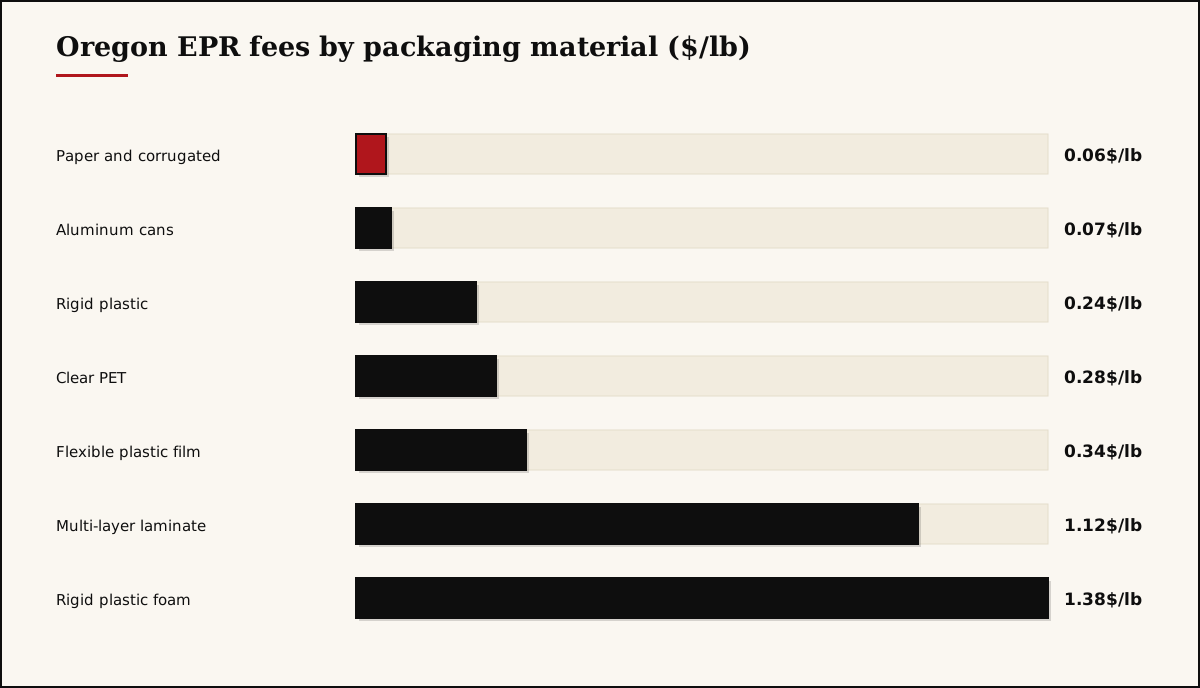
The spread is the point. Oregon's published rates run from around $0.06 per pound for paper and corrugated up to $1.38 per pound for rigid plastic foam, with flexible film around $0.34 and multi-layer laminate above $1.10 (EcoEnclose, EPR Atlas). Foam peanuts and metallized laminate pouches are now roughly twenty times more expensive per pound to ship into these states than the corrugated they sit inside.
That reprices a specific set of decisions: foam void fill versus paper, laminate pouches versus paper-based ones, plastic tape versus water-activated paper tape. None of those are brand decisions. All of them are now cost decisions with a published rate card.
What the unboxing research does and does not say
Search for unboxing statistics and you will find confident numbers: premium packaging lifts repeat purchase by 40% to 61%, custom packaging cuts returns by 15%, some large share of buyers share unboxings on social. Follow the citations and they almost always terminate in another packaging vendor's blog. There is no accessible primary study behind most of them. Shopify's own packaging guide repeats an 82% willingness-to-pay figure for sustainable packaging without linking a source (Shopify).
The better-evidenced picture is more restrained. McKinsey's 2025 global packaging survey, covering more than 11,000 consumers across 11 countries, found that while over half say they would pay more for sustainable packaging, willingness has fallen against prior years and value for money is reasserting itself. In the US, only about 13% said they would pay "a lot more" (McKinsey).
Stated willingness to pay is a weak predictor of behavior at the best of times. Use it to rule things out, not to justify a six-figure packaging program.
The tooling, what it costs, and when it is wrong
| Tool | Typical cost | Use it when | Wrong choice when |
|---|---|---|---|
| Custom printed mailer box | $2 to $5 per unit at 100 to 500 units, near $2.65 at 10,000 (Shopify) | Rigid or fragile goods, high AOV, gifting occasions | AOV under about $40, or your product ships fine in a mailer |
| Printed poly mailer | $0.40 to $3 per printed unit, low minimums (Shopify) | Soft goods, apparel, anything crush-tolerant | Anything with corners, glass, or a fragile closure |
| Cartonization in the WMS or 3PL | Bundled or low four figures a year | Mixed-basket orders and three or more box sizes in play | Single-SKU orders, or a 3PL that will not follow the recommendation |
| Loop or Redo for returns data | Loop Essential about $155 per month, Advanced about $272 (StackScored) | You need damage-coded return reasons to justify pack changes | Your return volume is too low for the reason codes to separate |
| Gorgias or Zendesk tag analysis | Gorgias Starter about $10 per month, Basic about $60, billed on ticket volume (Gorgias) | Quantifying "arrived damaged" contacts per 1,000 orders | You do not tag consistently, in which case fix tagging first |
| Okendo or Junip post-purchase surveys | Okendo Essential about $19 per month, scaling with order volume (Okendo) | Attaching packaging questions to review requests you already send | You are surveying for sentiment rather than a specific decision |
Two notes on this table. Cartonization software is oversold at this revenue band. If you ship a narrow SKU set from one facility, a written three-box decision rule at the pack bench captures most of the benefit at no cost. And returns platforms only help here if you enforce a damage reason code that is distinct from "not as described", because otherwise the two collapse and you cannot separate a packaging problem from a product page problem.
A packaging P&L you can actually run
Build one row per SKU family, not one row for the store.
- Pack material cost per order, including tape, void fill and inserts.
- Billable weight under the current pack, computed with the 139 divisor and inch-up rounding, weighted by your real zone mix.
- Damage and reship rate, pulled from returns reason codes and support tags over the trailing 90 days.
- EPR fee exposure: pounds of each material shipped into Oregon, Colorado and California, times the published rate.
- Contribution margin per delivered order after all four.
Then change one variable and rerun. The discipline is the same as any other unit-economics work, which is why it belongs next to the rest of your finance dashboard metrics rather than in a supplier email thread.
Our take
Most packaging projects at this revenue band are sequenced backwards. Brands start with print and finish with structure, because print is the part the founder can see. That is the wrong order, and it is expensive.
Our position: solve structure first, in this sequence. Get the box dimensions right against the 139 divisor and your zone mix. Get the damage rate down. Get the material mix off the high-fee EPR categories. Only then spend on print, and only on the SKU families where AOV supports it. Structure changes have a mechanism you can trace to a number. Print changes have a mechanism you cannot.
We will also take the unpopular side of the sustainability argument. Do not run a packaging sustainability program on the theory that customers will pay more for it, because the survey evidence for that is weakening and stated preference was never reliable anyway. Run it because EPR has put a published price on grams of foam and laminate, and because lighter, smaller, single-material packs are simultaneously cheaper to ship. The environmental case and the freight case now point the same direction. That is a much sturdier reason to act than a consumer sentiment number.
The one place we would spend on delight without a hard model is the first order for a high-consideration product over roughly $120 AOV, where the parcel is the first physical contact with a brand the customer has only seen in ads. Even there, we would cap it and test it against a control, the same way we would test anything else in a CRO program.
Conventional wisdom says packaging is a branding decision with a cost attached. We think it is a logistics decision with a branding opportunity attached, and the brands that get this right treat it as an ops workstream with a designer consulted, not a design workstream with ops consulted.
What to do this week
- Measure your five highest-volume packs with a tape and compute billable weight at the 139 divisor with fractional inches rounded up. Compare that to what you were actually billed last month.
- Pull 90 days of returns and support tags, and separate "arrived damaged" from every other reason code. Convert it to incidents per 1,000 orders per SKU family.
- List every packaging component by material and weight, then check your exposure against the Oregon, Colorado and California EPR thresholds and rates.
- Identify one component you can move off a high-fee material category, foam void fill or laminate being the usual candidates, and price the swap.
- Put pack material, freight, damage and EPR into a single per-order model, and stop approving packaging changes on the material quote alone.
If you want a second set of eyes on that model, we do this as part of consulting and growth retainer work. Book a 30 minute call and bring your pack dimensions, zone mix and returns reason codes, or request a custom quote if you already know the scope. If you would rather start with the storefront side, our free audit covers the conversion and merchandising layer that sits upstream of all of this.
Frequently asked questions
There is no universal benchmark worth trusting. Model it instead. Add the pack material cost, the freight difference your box size creates, the damage and reship rate, and any EPR fee on the weight you ship. Judge the total against contribution margin per order, not against a percentage someone published.
The widely circulated percentages come from packaging vendors and rarely cite a primary study. Treat them as marketing. The defensible mechanism is narrower: packaging that arrives undamaged and is easy to open protects the repeat rate you already have. Test print separately from structure.
Carriers bill the greater of actual weight and dimensional weight, which is length times width times height divided by 139 for UPS and FedEx domestic. Since August 2025 both carriers round every fractional inch up before that calculation, so a slightly oversized box now costs real money on every parcel.
Often yes. Oregon and Colorado exempt producers under roughly $5M in global revenue or under one ton of material, and California exempts under $1M in state sales. A brand doing $5M to $20M usually clears those thresholds and owes fees on every pound of packaging it puts into those states.
On freight and EPR weight, usually. On damage rate, not for anything rigid, fragile or high value. The right test is total cost per delivered order including reships and support contacts, run per SKU family rather than store-wide.
Only if your 3PL or WMS can act on it and you ship enough mixed-item orders for box selection to be a real decision. Under a few hundred orders a day with a narrow SKU set, a documented three-box decision rule taped to the pack bench captures most of the same saving for nothing.
One-page resource
Get the Small Store Revenue Checklist.
The 12 things that actually move revenue on a store under $50K a month, in the order we'd fix them. Delivered to your inbox.