
Field notes
Offer Architecture for D2C: Bundles, Tiers, Guarantees
August 4, 2026

A skincare brand doing about $6M runs a promotion calendar with four offers live at once: a 15% welcome code, free shipping over $50, a three-step routine bundle at 20% off, and a loyalty tier that adds another 5% for repeat buyers. AOV has climbed from $61 to $74 over eighteen months. The founder reads that as a win. Then finance rebuilds contribution margin by order and finds gross profit per order has moved from $27.40 to $27.10. The AOV lift was real. It was also entirely funded by the brand.
This is the most common failure in D2C offer design. Teams optimize a metric that sits above the line they actually care about, then buy the improvement with discount dollars they never priced. AOV is a compound number. It moves when units per order rise, when average unit retail rises, and when discount rate falls. Three of those levers are yours. Discount is the one that always works and always costs.
Offer architecture is the discipline of deciding which lever each offer pulls, then making sure two offers do not pull opposite levers on the same order. Most brands at $2M to $20M have offers. Very few have architecture.
TL;DR
- AOV is a compound metric. Decompose it into units per order, average unit retail and discount rate before you optimize anything, or you will pay for the lift twice.
- Tiers move average unit retail. Bundles move units per order. Guarantees move conversion. Discounts move nothing structural and cost real money. Deploy them in that order.
- Good-better-best works because people evaluate relative value, not absolute value. The premium tier earns its place by making the target tier legible, not by selling volume.
- Guarantees are a priced instrument. NRF put 2025 online returns at 19.3% of sales. A stronger guarantee raises conversion and returns together, so run the arithmetic rather than the vibe.
- Shopify's discount combination rules cap what you can stack. Design the offer set inside those constraints instead of discovering them mid-promo.
Decompose AOV before you touch it
AOV = (units per order x average unit retail) - discount per order, plus whatever shipping revenue you book. Four brands can post the same $80 AOV with completely different economics behind it.
| Path to $80 AOV | Units | AUR | Discount | Gross profit per order at 65% product margin |
|---|---|---|---|---|
| One premium unit | 1 | $80 | $0 | $52.00 |
| Two mid units | 2 | $44 | $8 | $49.20 |
| Three entry units, bundled | 3 | $32 | $16 | $46.40 |
| One unit plus heavy code | 1 | $100 | $20 | $45.00 |
The bundled row looks worst on percentage margin and often is not worst in practice, because fulfillment, payment processing and support cost are largely per order rather than per unit. Once you load a $6 pick-and-pack and a $2.60 payment fee onto each order, the three-unit row is spreading fixed cost across more revenue than the single-unit row. That is the actual case for bundling, and it is a cost-structure argument, not a psychology argument.
Which is why the first thing we do on any offer engagement is rebuild the AOV series into its three components by month. Brands are usually surprised. A flat AOV line very often hides rising discount rate cancelling out rising units per order. Our DTC finance dashboard post covers the reporting layer for this.
Tiers move average unit retail
Rafi Mohammed's good-better-best framework, published in Harvard Business Review in 2018, remains the cleanest articulation of why three tiers beat one. You add or remove features to create variably priced versions of the same underlying product, capturing customers at different willingness-to-pay bands rather than forcing everyone through one price.
The mechanism worth understanding is that customers judge relative value far better than absolute value. Dan Ariely's Economist subscription experiment, summarized by Shopify, remains the standard demonstration: with a $59 web-only, $125 print-only and $125 print-plus-web set, 84% chose the bundle. Remove the print-only option and 68% switched to the cheap web tier. The dominated option sold almost nothing and changed almost everything.
Be careful how much weight you put on that. Recent field data is more sober than the lab result. A 2025 study in npj Science of Learning analyzed 3.6 million UK wine transactions across 755,158 customers and found the attraction effect present but modest, roughly a 1% to 2% shift in preference, and significantly weaker among frequent buyers who knew the category. Your best customers are the least susceptible.
The practical read: build three tiers because they let you serve three willingness-to-pay bands and because they make your target tier legible. Do not build them expecting a 50 point swing in mix. Expect a few points, and expect the effect to fade as customers get familiar with your range.
Tier design that works in D2C:
- Entry tier: smallest viable format, full price per unit. Its job is to remove the "too expensive to try" objection, not to make money.
- Target tier: the one your merchandising, imagery and copy point at. Best margin dollars per order. Usually a 2x or 3x format or a curated set.
- Premium tier: 40% to 100% above the target. Sells in low volume and does real work anchoring the target's value.
Bundles move units per order
Bundles are the highest leverage mechanic available to most D2C brands because they attack the per-order cost problem directly. The trap is pricing them as a discount rather than as a format.
A discount-priced bundle says "buy three, save 20%." A format-priced bundle says "the 90-day routine, $96." The second one does not invite the customer to compute what they saved, so it does not train them to wait for the saving. It also lets you build a SKU with its own imagery, its own PDP and its own ad creative.
On tooling, start with what the platform gives you. Shopify Bundles is free, decrements component inventory correctly and handles fixed bundles and multipacks. It caps at three options and 100 variant combinations, which is fine for supplements and skincare and painful for apparel. We covered the app landscape in more depth in our product bundles guide, and the merchandising apps in upsell and cross-sell apps compared.
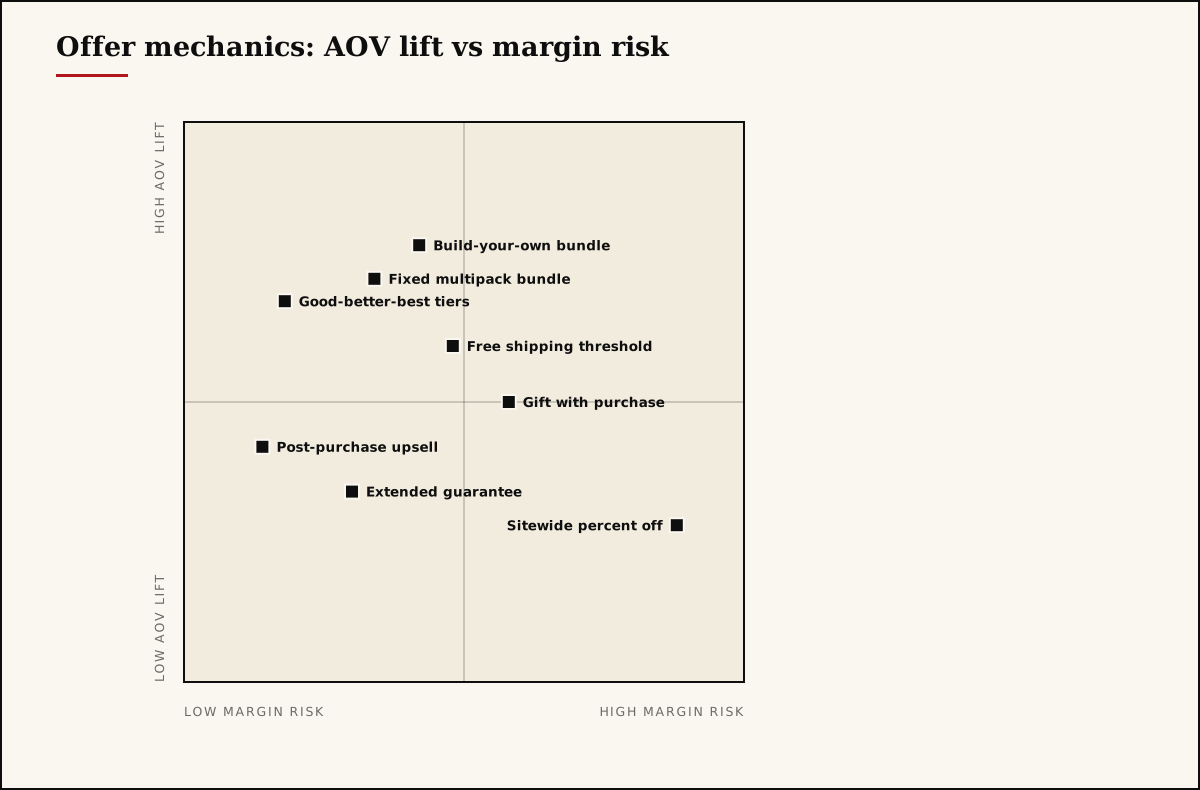
The matrix is the summary of the argument. Tiers and format-priced bundles sit in the useful quadrant. Sitewide percentage discounts sit alone in the corner nobody should want, high margin risk for weak structural lift, which is exactly why they are the default when a quarter is short.
Guarantees move conversion, and they cost money
Guarantees are the least understood item on the list because they are usually treated as copy rather than as a priced instrument.
The demand side is well documented. Baymard's cart abandonment research, updated in 2025, puts documented average abandonment at 70.22% and lists an unsatisfactory returns policy as the reason for 13% of abandonments among shoppers who intended to buy. Baymard separately notes that lack of early access to the returns policy is a source of anxiety during product research, particularly in apparel.
The cost side is equally well documented. NRF's 2025 Retail Returns Landscape estimates $849.9 billion in total returns and a 19.3% online return rate, with 9% of returns judged fraudulent.
Both things are true. A stronger guarantee lifts conversion and lifts returns. That is not a reason to avoid it, it is a reason to size it. The test is whether incremental contribution from newly converted buyers exceeds incremental reverse logistics cost, and you can run that on a 60-day holdout by category rather than sitewide.
Three guarantee structures we see working, in rough order of how well they hold margin:
- Outcome guarantee with a usage condition. "Finish the 60-day supply and if your skin has not changed, we refund it." The condition suppresses casual returns while still removing the risk that blocks a first purchase.
- Fit or exchange guarantee. Steers the resolution toward an exchange rather than a refund, which keeps the revenue and only costs freight.
- Straight money-back window. Simplest to communicate, most expensive to run, and the right choice for high-consideration first purchases where the risk objection is the binding constraint.
Our returns policy piece covers the drafting side. What matters architecturally is that the guarantee is a line item in your contribution model with an owner, not a sentence in the footer.
The tool layer, and where each one is wrong
| Tool | Cost | Best for | Wrong choice when |
|---|---|---|---|
| Shopify Bundles | Free | Fixed bundles and multipacks with simple variants | Apparel or anything past three options and 100 combinations |
| Rebuy | From $25/mo per package, Platform One at $534/mo | Cross-sell and post-purchase logic across cart and checkout | You need it to fix a merchandising strategy that does not exist yet |
| Recharge | Starter $99/mo plus 1.49% + 19c; Plus $499/mo on annual | Subscription tiers and prepaid formats at real volume | Subscription is a pricing experiment rather than a committed program |
| Loop Returns | Essential $155/mo, Advanced $272/mo | Turning a guarantee into exchanges rather than refunds | Return volume is low enough that manual handling is cheaper |
| Okendo | Quoted by monthly order volume | Attribute-level review data that de-risks tier and fit decisions | You want star ratings only, which cheaper tools handle |
| Triple Whale | Starter $299/mo up to Professional $749/mo, priced on GMV | Reading offer performance against blended profit, not channel ROAS | Your source data is not clean enough to trust any dashboard |
Notice what is missing: nothing on this list creates an offer. They execute and measure offers. The sequencing error we see most is a brand buying a $534 per month merchandising engine before it has decided what its target tier is.
Stacking rules are a design constraint, not an afterthought
Shopify's discount combination rules set hard limits. A customer can use at most five product or order discount codes plus one shipping discount code on one order. You can have up to 25 active automatic discounts. Multiple product discounts on the same line item require Shopify Plus. Product discounts apply first, then order discounts on the revised subtotal, then shipping.
Two consequences that bite in practice. First, a bundle discount and a welcome code frequently target the same line item, so only one applies, and your welcome-flow conversion silently drops on bundle SKUs. Second, the order of operations means a 15% order discount stacked behind a 20% product discount is calculated on the already-reduced subtotal, which is cheaper than most people assume and worth exploiting deliberately.
Write the stacking matrix before the promo calendar. Which offers combine, which are exclusive, and what the worst-case discount on a single order is. If you cannot state your maximum possible discount rate from memory, you do not have one.
Our take
Most D2C brands should stop discounting to lift AOV entirely, and should stop measuring offer performance on AOV at all.
The reasoning is mechanical. A discount is the only AOV lever with a guaranteed, immediate, fully-loaded cost and no structural residue. Raise units per order through bundling and you have built a SKU that keeps working. Raise average unit retail through tiering and you have built a price architecture that keeps working. Cut price and you have bought this month's number and taught a cohort of customers what your product is really worth. That lesson compounds against you, because the customers most responsive to discount are the ones with the worst repeat behavior, which shows up later as a degraded LTV curve that nobody traces back to the promo calendar.
The conventional wisdom we disagree with most directly is "raise your free shipping threshold to lift AOV." It works, in the narrow sense that AOV goes up. It also loads freight cost onto exactly the orders that just cleared the bar with the cheapest possible add-on, which is where your worst per-order economics live. If you are going to run a threshold, measure it on gross profit per session and be willing to find that the higher threshold lost money.
The second thing we would push back on is the reflex to add a fourth or fifth tier. Every additional option adds decision cost, and the wine study suggests the choice-architecture benefit is small to begin with and smaller among your repeat customers. Three tiers, priced with real gaps, beat five tiers with fuzzy differences almost every time.
Where we would spend instead: guarantee design. It is the only mechanic on this list that raises conversion and average order value at the same time, because a customer who trusts the outcome buys the larger format. Most brands treat it as legal copy. Treated as an offer, it is usually the cheapest structural lift available, and it is measurable inside a quarter. Pair it with a disciplined checkout audit and you are attacking both halves of the same objection.
What to do this week
- Rebuild your last 12 months of AOV into units per order, average unit retail and discount rate, by month. Look at what actually moved.
- Calculate gross profit per order, not percentage margin, for your top five offer paths. Rank them. Kill the bottom one.
- Write the stacking matrix for every live offer and state your worst-case discount on a single order in one number.
- Reprice your best-selling bundle as a format with its own name and price, not as a percentage off, and give it a real PDP.
- Pick one category and draft an outcome-conditioned guarantee, then model the breakeven return rate at which it stops paying.
If you want a second set of eyes on the arithmetic before you change anything, book a call and we will walk your offer set and contribution model together. If you already know the scope of the work, request a custom quote. If you would rather start with the store itself, our free audit covers the merchandising and checkout surface where most of these offers actually live or die.
Frequently asked questions
Three in most categories. One entry option that removes the price objection, one target option you actually want to sell, and one premium option that anchors the target. A fourth tier usually adds decision cost without adding revenue, unless your customer base genuinely splits across four willingness-to-pay bands.
No, but it does if you price the bundle off retail instead of off contribution. A three-unit bundle at 12% off can print more gross profit dollars per order than one unit at full price, because you spread the same pick, pack, ship and payment cost across more units. Model gross profit per order, not percentage margin.
Above your current AOV, close enough that the median cart can reach it by adding one realistic item. If the gap needs two or three additions, most shoppers stop trying. Test the threshold against gross profit per session, not AOV alone, because a threshold that lifts AOV can still lose money once you absorb the freight.
Usually yes, and the honest answer is that they raise both conversion and returns. NRF put the 2025 online return rate at 19.3%. The question is not whether a stronger guarantee lifts returns, it is whether the incremental contribution from newly converted buyers exceeds the incremental reverse logistics cost. That is arithmetic you can run.
Start native. Shopify Bundles is free and handles fixed bundles and multipacks with correct inventory decrementing, though it caps at three options and 100 variant combinations. Move to a paid platform only when the merchandising logic you need cannot be expressed in native discounts and bundles.
Discount combination rules. Shopify allows a maximum of five product or order discount codes plus one shipping discount code on a single order, and only one product discount per line item outside Shopify Plus. Brands running a bundle, a threshold, a loyalty perk and a code at once discover the conflict in production, usually during a promo.
One-page resource
Get the Small Store Revenue Checklist.
The 12 things that actually move revenue on a store under $50K a month, in the order we'd fix them. Delivered to your inbox.