
Field notes
The First 10 Hires for a $5M D2C Brand
August 4, 2026

A founder we spoke to runs a $5.4M skincare brand on Shopify. Nine people on payroll. She is the CEO, the head of merchandising, the one who approves every creative brief and the person who answers the 3PL when a container is late. Her gross margin is fine. Her contribution margin is fine. Her problem is that four of those nine hires were made in the order the pain arrived rather than the order the leverage arrived, and now she has a social media coordinator and no one who owns inventory planning.
That is the actual failure mode at this stage. Not overhiring, though that happens. Not underhiring either. It is hiring in the wrong sequence, because the loudest pain and the highest leverage are almost never the same thing. The loudest pain at $5M is usually customer support tickets and creative volume. The highest leverage is usually inventory, retention and the reporting layer that tells you which of the other two is lying to you.
This piece is a sequencing model, not a job board. It assumes you already know what a growth marketer does.
TL;DR
- Benchmarks put a $5M D2C brand at roughly 8 to 15 FTEs, with $10M brands at 15 to 25 and a target of $500K to $700K of revenue per employee across the $10M to $100M range (Eightx).
- Sequence by leverage, not by pain. The right first hire is the one that removes a constraint on the whole system, which at $5M is almost always operations or retention, not paid media.
- Apply the rent-versus-own test before every req. Media buying, front-end dev and bookkeeping stay rented far longer than most founders think.
- Your tool stack is a hiring decision. Brands in the $5M to $20M band spend $5,000 to $15,000 a month on Shopify apps (Eightx), and each of those line items either replaces a person or requires one.
- EBITDA compressed across every D2C cohort in 2025, with under-$10M brands falling from 11.33% to 6.15% (A2X, from the 2026 Ecom P&L Benchmark Report). Payroll decisions made in 2026 are being made against thinner cover than the ones made in 2023.
What the headcount data actually says
Start with the constraint. Independent benchmarking of D2C headcount by revenue band puts a $5M brand at 8 to 15 FTEs and a $10M brand at 15 to 25, with an operating target of $500K to $700K of revenue per employee (Eightx). The public D2C cohort runs a median of about $720K per employee, with the leanest brands above $1.2M and retail-heavy ones down in the $200K to $300K range.
Two things follow. First, at $5M you are budgeting for roughly ten people, so the marginal hire is 10% of your team and each one is a real allocation decision. Second, the brands that stay lean share structural traits rather than heroic ones: no owned retail, no in-house manufacturing, and aggressive use of 3PL and agency capacity. Leanness is a set of decisions about what not to own.
The financial backdrop matters too. Across cohorts in 2025, EBITDA fell, with sub-$10M brands dropping from 11.33% to 6.15% and mid-market from 12.26% to 7.80% (A2X), while revenue growth was flat to modest depending on cohort (Ecom CFO). Payroll is the largest reversible cost in a D2C P&L and the slowest to reverse.
The rent-versus-own test
Before any req, run two questions. Is this function a commodity or a compounding advantage? And is the knowledge it generates portable or does it have to live inside the company?
Media buying scores badly on both. The supply of competent buyers is deep, the feedback loop is measured in days, and the account knowledge transfers with a shared login. Inventory planning scores the opposite way: the knowledge is your specific SKUs, your specific lead times and your specific seasonality, and it cannot be handed back in a Loom video.
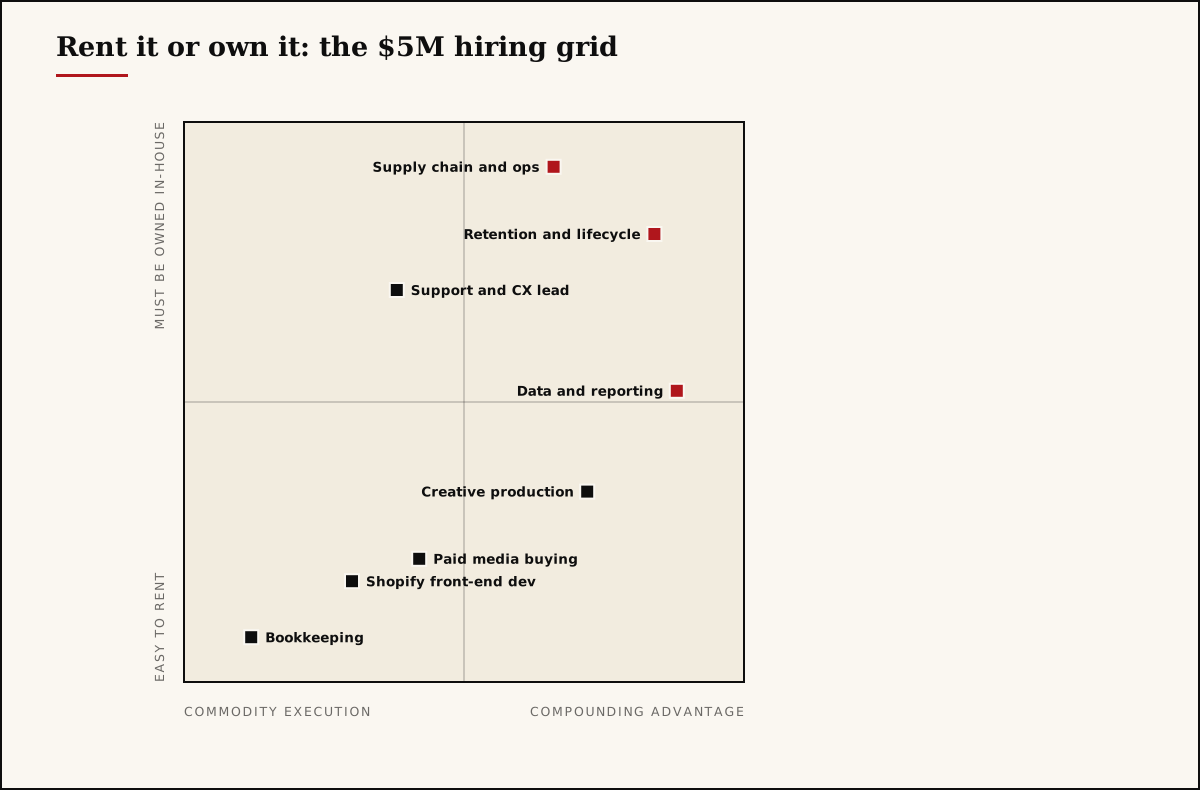
The bottom-left quadrant is where you should be spending money on vendors and software, not salaries. The top-right is where a full-time hire earns its cost even when the person is overqualified for their current workload, because the compounding starts on day one.
The sequence
This assumes a founder or founding pair already covering brand, merchandising and final approvals. If you are a single founder, roles 1 and 2 shift earlier.
| # | Role | Why here | Typical US base |
|---|---|---|---|
| 1 | Ecommerce / ops manager | Owns site, catalog, promos, 3PL relationship. Buys the founder back 15 hours a week | $75,000 to $100,000 |
| 2 | Customer experience lead | Owns tickets, returns, and the feedback loop into product | $55,000 to $75,000 |
| 3 | Retention / lifecycle owner | Email, SMS, segmentation, post-purchase. The highest-margin revenue you have | $70,000 to $95,000 |
| 4 | Supply chain / inventory planner | Stockouts and overstock are the two largest silent P&L leaks at this size | $75,000 to $105,000 |
| 5 | Creative producer | Turns concepts into volume. Manages freelancers and UGC creators | $60,000 to $85,000 |
| 6 | Growth marketer | Owns blended efficiency across channels rather than one platform | $85,000 to $120,000 |
| 7 | CX associate (second) | Support scales with orders, not with revenue | $45,000 to $60,000 |
| 8 | Merchandiser / product developer | Assortment becomes the growth lever once acquisition plateaus | $70,000 to $100,000 |
| 9 | Analyst or ops engineer | Reporting, integrations, the boring plumbing that unblocks everyone | $80,000 to $115,000 |
| 10 | Second retention or second growth hire | Whichever channel is actually constrained by hours | $65,000 to $95,000 |
Salary bands are US market observations from published ecommerce compensation guides (Constant Hire, eCommerce Placement). For senior marketing leadership, the BLS puts the national median wage for marketing managers at $166,790 as of May 2025 (BLS OEWS), which is a useful reality check before you write "VP" on a req at $5M.
Fully loaded, that ten adds roughly 25% to 30% on top of base for taxes, benefits and equipment. Ten roles land between $700,000 and $1.1M.
Why paid media is not hire number one
This is where most $5M brands go wrong, so it deserves the mechanism rather than the assertion.
A media buyer's output is a function of three inputs: budget, creative volume and offer. At $5M, budget is capped by your cash conversion cycle, creative volume is capped by whoever is making assets, and the offer is set by merchandising. Hiring a buyer without fixing those three does not increase output. It increases the number of people waiting on the same bottleneck.
The rented version of this role is genuinely good and genuinely cheap relative to salary. In-house Meta specialists command roughly $70,000 to $120,000, and more in high-cost metros (Remotely Talents). A competent freelancer or a small agency retainer sits well below that and comes with pattern recognition across accounts you will never have. The benchmark data agrees: lean brands stay on agency paid media through $25M (Eightx).
Bring it in-house when the account needs daily judgment calls that a shared Slack channel cannot support, or when your creative volume is high enough that the buyer is the person launching twenty tests a week. Not before. If you are unsure whether your paid spend is even the constraint, that is a measurement question first, and we have covered how to read it in MER vs ROAS.
Tools that replace hires, and tools that create them
Every app in your stack is either substituting for labor or generating it. Brands in the $5M to $20M band typically run 10 to 12 paid apps at $5,000 to $15,000 a month (Eightx). That is one to two junior salaries in software, which is fine if the substitution is real and expensive if it is not.
| Tool | Rough cost | Replaces or reduces | When it is the wrong call |
|---|---|---|---|
| Klaviyo | About $150/mo at 10K profiles, $720/mo at 50K (Omnisend) | Nothing on its own | Buying it before anyone owns lifecycle. It is a lever, not an operator |
| Gorgias | Starter $10, Basic $60, Pro $360, Advanced $900 (Chatarmin) | Roughly one CX associate at moderate volume | Sub-500 tickets a month, where a shared inbox is genuinely fine |
| Gorgias AI Agent | About $0.90 per resolved conversation on annual (Chatarmin) | The second and third CX hire | Complex or high-AOV support where a wrong answer costs a customer |
| Triple Whale | Roughly $149 to $1,290/mo by GMV tier (SignalBridge) | Part of an analyst's reporting work | When nobody has time to act on what it surfaces |
| Northbeam | Starter from about $1,500/mo (wetracked.io) | Nothing at $5M | Below roughly $250K a month in ad spend, the precision does not change decisions |
| Recharge | Around $300/mo plus transaction fees (Eightx) | Subscription ops labor | Without an owner, churn and dunning quietly eat the gains |
| Okendo or Yotpo | About $150 to $1,000/mo (Eightx) | Manual review chasing | When nobody is merchandising the reviews onto the PDP |
The pattern is consistent. Tools substitute cleanly for execution labor and substitute badly for ownership. Support automation genuinely removes headcount, and the benchmark view is that a four-person CX team using AI agents now covers what took ten to twelve people a few years ago (Eightx). No tool has ever removed the need for someone to decide what the brand does next. If you are weighing support automation specifically, we went deeper in AI support for D2C brands.
Our take
Three positions, and we will defend the reasoning rather than the vibe.
Hire the retention owner before the acquisition owner, even though acquisition is where the growth is. The argument for acquisition-first is that new customers fund everything. True. But at $5M you already have a customer file, and the marginal cost of revenue from that file is close to zero while the marginal cost of new revenue is your CAC. A retention owner is working on the highest-margin revenue in the business from week one, and their work compounds into the acquisition math by raising what you can afford to pay for a customer. An acquisition hire without a retention owner is buying customers into a leaky file. The mechanism is simple arithmetic on customer lifetime value, not a philosophy.
Do not hire a data analyst at $5M. This is the hire founders feel most virtuous about and it is usually wrong at this size. The failure is not that data is unimportant. It is that at $5M you have maybe fifteen decisions a quarter that data could change, and a full-time analyst will produce far more output than that, most of which becomes dashboards nobody opens. Buy the reporting layer, make the founder or the ops manager read it weekly, and hire the analyst when you can name five decisions a month that are currently being made blind. Our D2C finance dashboard piece covers what that layer needs to show.
Fractional beats junior for anything that requires judgment. Conventional advice says stretch the budget and hire a junior you can grow. That works for execution roles where reps build skill. It fails badly for judgment roles, because a junior in a judgment seat produces decisions at junior quality and you will not know which ones were wrong for two quarters. Finance, supply chain strategy and measurement architecture are all better bought as eight hours a month of someone senior than forty hours a week of someone learning. The retainer versus project framing applies here directly.
The uncomfortable implication of all three is that the correct headcount at $5M is smaller than most founders want, and the correct vendor spend is larger. Payroll feels like control. It is mostly commitment.
What to do this week
- List every function in the business and place it on the rent-versus-own grid before you write another job description.
- Pull your last twelve months of app spend and mark each line as replacing labor, creating labor or doing neither. Cancel the third category.
- Calculate your current revenue per FTE and compare it against the $500K to $700K operating band. If you are well under, the next hire is probably not a hire.
- Write your next req as a list of decisions the person will own. If you cannot name five, the work is a vendor or a tool.
- Name the single constraint on the business right now, in one sentence. Sequence the next hire against that sentence and nothing else.
If you want a second opinion on the sequence before you commit $200,000 of payroll to it, that is exactly the kind of question we take on. Book a call and we will walk your P&L, your stack and your org chart together, or request a custom quote if you would rather scope a specific engagement first.
Frequently asked questions
Benchmarks put a $5M brand at roughly 8 to 15 full-time employees, with a midpoint near 11 or 12. That count usually excludes the 3PL, the paid media agency and any fractional finance support, so the working team touching the business is often larger than the payroll suggests.
Usually not. Media buying is the most rentable function in D2C because the supply of competent freelancers and agencies is deep and the feedback loop is fast. A brand that hires a media buyer first typically ends up paying a salary for capacity it could have bought by the hour while the real constraint sits in ops or retention.
At US market rates, ten roles at a $5M brand land somewhere between $700,000 and $1.1M in fully loaded payroll, depending on how many are senior and where they sit. That is a large share of contribution margin, which is why sequencing matters more than any individual hire.
When creative volume becomes the bottleneck rather than creative quality. If you need a handful of new concepts a month, freelancers win. If your paid account needs dozens of assets a month and turnaround time is throttling testing, an in-house producer starts to pay for itself.
It is usually a luxury at $5M and a necessity by $15M. Below that, a well-configured reporting stack plus a founder who reads it weekly beats a junior analyst producing dashboards nobody acts on. Buy the tooling first and see whether the questions you cannot answer are actually data problems.
Write the job description as a list of decisions, not tasks. If every line is a task, some software or an AI agent probably already does it. If the role owns judgment calls with money attached, it is a real hire.
One-page resource
Get the Small Store Revenue Checklist.
The 12 things that actually move revenue on a store under $50K a month, in the order we'd fix them. Delivered to your inbox.