
Field notes
Creative Operations: The System Behind Ad Performance
July 29, 2026

A brand doing $8M a year on Shopify has three people who touch paid creative. The founder approves everything. A freelance editor turns around whatever gets sent. The media buyer, who is on a retainer with an agency, asks for "more UGC" every two weeks. Ads get named things like new_video_final_v3. Nobody can answer the question "which hook has produced our best cost per acquisition in the last ninety days" without opening three tools and guessing.
That brand's media buying is not the problem. The buying is fine. The problem is that the system feeding the buying produces four usable assets a month, on an irregular schedule, with no memory of what was tried before. When a winner fatigues, there is nothing behind it. Costs rise, the founder blames the agency, the agency blames the creative, and the account slides for a quarter.
Creative operations is the unglamorous machinery that fixes this: how insight becomes a brief, how a brief becomes an asset, how an asset gets named, launched, read and recycled. It is a supply chain problem dressed up as a marketing problem, and almost nobody in the $2M to $20M band has actually built one.
TL;DR
- Creative quality is the largest single lever in advertising outcomes, but quality at volume is an operations question, not a taste question.
- The bottleneck for most brands is not ideas or editing. It is briefing, approval and asset retrieval. Adobe's 2025 research found administration, reviews and approvals consume 41 percent of content creation time.
- Your naming convention is your analytics layer. Get it wrong and no tool will save you. Get it right and you may not need the tool.
- Buy throughput before you buy software. A $750 a month creative analytics seat is worse value than a second editor if you are producing six assets a month.
- Refresh on signal, not on calendar. Both Meta and TikTok now surface degradation signals directly in their delivery reporting.
The constraint is throughput, not taste
Nielsen's analysis of roughly 500 campaigns found creative to be the most important single contributor to advertising outcomes, ahead of reach, targeting and context, with the influence of media rising over the same period (Nielsen, 2017). Kantar and WARC, matching about 450 ads against a return-on-marketing-investment database, found the most creative and effective ads generated more than four times as much profit (Kantar).
Operators read that and conclude they need better ads. The more useful conclusion is that they need more shots at a better ad, because creative quality is not reliably predictable in advance. You cannot pick the winner in the room. You can only increase the number of legitimate attempts and shorten the time between attempt and read.
That reframes the whole problem. "Make better creative" is not an executable instruction. "Ship twelve distinct concepts this month, each briefed against a specific claim, and read them at concept level on the fifteenth" is.
The pressure is also structural. Meta's Q2 2025 results showed ad impressions up 11 percent year over year and average price per ad up 9 percent (Meta investor relations). More inventory and higher clearing prices at the same time means the auction is absorbing more advertisers who are bidding harder. The only durable defense is a higher hit rate on creative, and the only route to a higher hit rate is more disciplined attempts.
Map your creative supply chain before you buy anything
Before choosing tools, draw the actual path an idea takes from the moment someone notices it to the moment it stops running. Most brands have never drawn it, and the drawing itself usually surfaces two or three stages that simply do not exist.
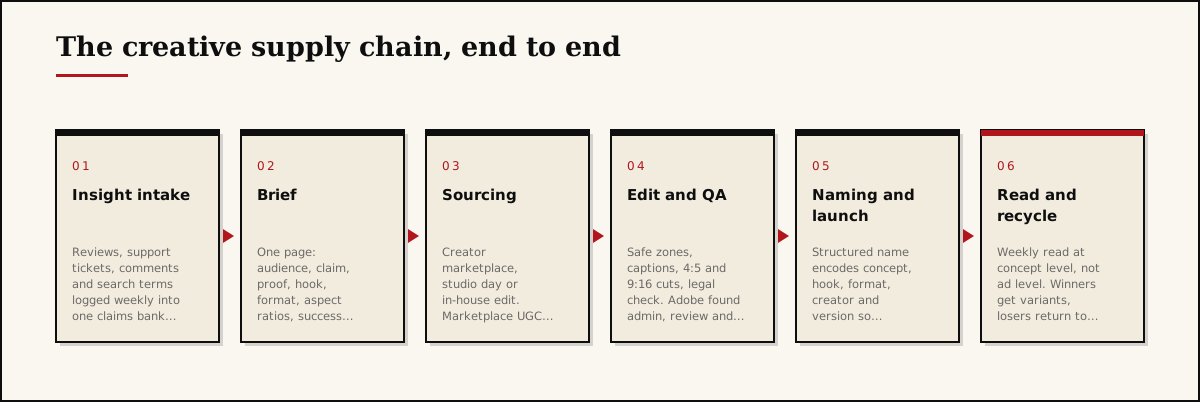
The two stages brands skip most often are the first and the last. Insight intake is the difference between briefing from opinion and briefing from evidence. Recycling is the difference between a losing ad being a wasted $400 and a losing ad being a data point that narrows the next ten briefs.
The brief is the unit of production
Stop treating the video as the unit of work. The video is an output. The brief is the thing you actually manage, schedule and count.
A brief that works for paid social fits on one page and specifies six things:
| Field | What it must contain | Common failure |
|---|---|---|
| Audience | A named segment with a stated belief or objection | "Women 25 to 45" |
| Claim | One specific, provable statement | Three claims stacked into one ad |
| Proof | The evidence that carries the claim, and its source | Assertion with no proof element |
| Hook | The first three seconds, written verbatim | "Start with something attention-grabbing" |
| Format and ratios | 9:16, 4:5, static or motion, caption treatment | One master file, cropped badly later |
| Success metric | The number that decides pass or fail, and the threshold | "See how it does" |
The claim and proof fields are where most briefs collapse. If you cannot name the proof, you do not have an ad, you have a slogan. Proof is a review quote, a demonstration, a before and after, a comparison, a certification, a founder explaining a decision. Our creative testing framework covers how to structure the test once the brief exists, and UGC content for paid ads covers the creator-sourced end of production.
The other reason to make the brief the unit is scheduling. You can commit to eight briefs a month. You cannot honestly commit to eight great videos, because production slips, creators cancel and edits get rejected. Briefs are countable, forecastable and reviewable in a way that finished assets are not.
Naming is your analytics layer
This is the single highest-return hour in creative operations, and it is free.
Every ad name should encode the fields you will later want to pivot on, in a fixed order, with a single delimiter and no spaces. A workable pattern:
CONCEPT_HOOK_FORMAT_SOURCE_RATIO_V1
For example: HARDWATER_PROBLEMFIRST_UGCVIDEO_CREATORJM_9x16_V2.
The test is simple. Export your ad-level report to a spreadsheet, split the name column on the delimiter, and pivot spend and cost per acquisition by hook. If that works in ninety seconds, your naming convention is correct. If it requires manual tagging, it is not.
This matters more than it sounds. McKinsey's work on knowledge work found interaction workers spend close to a fifth of the week looking for internal information (McKinsey). In a creative team that overhead lands on finding the right master file, the right cut, the right version. A naming convention that also governs your file storage removes most of it.
Apply the same discipline to the source files, not just the ad names. If the ad is HARDWATER_PROBLEMFIRST_UGCVIDEO_CREATORJM_9x16_V2, the folder holding the raw footage, the project file and the exports should be named to match. Two systems that disagree are worse than one loose system.
What to staff, what to buy, what to rent
Here is roughly where the money goes at different production volumes. Treat the numbers as planning anchors, not quotes.
| Capacity | Typical setup | Approximate monthly cost |
|---|---|---|
| 4 to 8 assets | Founder briefs, one contract editor, marketplace UGC | $1,500 to $3,500 |
| 10 to 20 assets | One creative strategist, contract editing, mixed sourcing | $9,000 to $14,000 |
| 25 to 40 assets | Strategist plus in-house editor, retained creators, monthly studio day | $18,000 to $28,000 |
| 50+ assets | Strategist, two editors, producer, standing creator roster | $35,000+ |
The salary inputs are real and public. Glassdoor puts the average in-house video editor in the US at around $79,000 a year, with a typical range from roughly $61,000 to $103,000 (Glassdoor). ZipRecruiter puts the average US creative strategist near $93,000 (ZipRecruiter). Marketplace UGC starts around $99 per video on Billo before the platform's marketplace fee, which sits between roughly 7 and 20 percent depending on plan (Billo).
The order of hiring matters more than the totals. The first hire is a creative strategist, not an editor. An editor with no briefing system produces polished assets that answer no question. A strategist with contract editors produces messy assets that answer many. You can fix production values later. You cannot retroactively add strategy to a library of pretty ads.
The tool stack, and when each one is wrong
| Tool | What it is for | Price | When it is the wrong choice |
|---|---|---|---|
| Foreplay | Ad library swipe file, brief building, creator briefs | From $59/mo monthly, $49/mo annual (pricing) | If nobody owns the swipe file, it becomes an expensive Pinterest board |
| Motion | Creative analytics, concept-level reporting across platforms | From $750/mo (pricing) | Under roughly 40 live assets, a naming convention and a spreadsheet do the same job |
| Triple Whale | Blended reporting, attribution, dashboarding | Starter $179/mo, Advanced $259/mo, Professional $749/mo (pricing) | If your creative naming is inconsistent, it will report the same mess faster |
| Billo / Insense | Creator sourcing at volume | From about $99 per video plus marketplace fee | If you need brand-controlled product demonstration or complex claims |
| Google Drive or Dropbox | Asset storage and versioning | $12 to $25 per user/mo | Once more than four people need to find final cuts without asking |
| Native Ads Manager reporting | Delivery diagnostics, breakdowns, A/B tests | Free | When you need concept-level rollups across Meta, TikTok and Google at once |
The single most common overspend we see is a brand paying for creative analytics while producing six assets a month. Analytics tools multiply the value of volume. They do not create it. If you have a choice between $750 a month on Motion and $750 a month on a second contract editor at your current volume, take the editor every time, and revisit the tool when your asset count makes the spreadsheet genuinely painful.
The second most common overspend is buying attribution software to solve a creative reporting problem. Those are different problems. If you are working through the measurement side, MER vs ROAS is the more relevant read.
Read on signal, not on calendar
Both major platforms now tell you when creative is degrading. Meta surfaces creative fatigue and creative limited statuses in Ads Manager's Delivery column, tied to cost per result moving against its own history (Meta Business Help Centre). TikTok's own guidance recommends three to five genuinely different creatives per ad group and advises refreshing "when delivery results exhibit a consistently declining trend, or when daily new users are low" rather than on a fixed schedule (TikTok Business Help Centre).
Calendar-based refresh is operationally convenient and economically wrong in both directions. It kills assets that are still working, and it lets failing assets run for the remainder of the month. Signal-based refresh requires a weekly review meeting with pre-agreed thresholds, which is harder to schedule and cheaper to run. Our creative refresh cadence guide goes deeper on the thresholds themselves, and PMax creative refresh covers the Google side, where asset group hygiene works differently.
The review should read at concept level, not ad level. Ad-level reads produce noise and encourage micro-optimization of thumbnails. Concept-level reads answer the question that actually changes next month's briefs: which claim, which audience belief, which proof type is working.
Our take
Two positions, both of which get argued with.
First: most brands under $20M should not build an in-house studio, and should build an in-house briefing function. The conventional advice is the reverse. Agencies and creator marketplaces will happily sell you strategy while you keep production in-house, because production is the visible, expensive, easily justified part. We think that is backwards. Production capacity is a commodity you can rent at reasonable rates in an hour. Briefing capacity is proprietary, compounds with every test you run, and cannot be outsourced without losing the institutional memory that makes the next brief better. The mechanism is straightforward: a brief is a bet on a hypothesis about your customer, and the value of the bet comes from everything you learned from the last hundred bets. Rent the camera. Own the hypothesis.
Second: the "ship more creative" advice has become actively harmful when it is decoupled from briefing. The volume argument is real, but it has degraded into producing thirty near-identical variants of one concept because the tooling makes that cheap. That is not diversity, it is duplication, and it burns budget while teaching you nothing. The useful unit of volume is distinct concepts, meaning different audience beliefs and different proof, not different fonts on the same footage. A brand shipping eight genuinely distinct concepts a month will out-learn a brand shipping forty variants of two, and will do it at lower cost. If your production system cannot tell you how many distinct concepts you shipped last month, you do not have a production system.
The consequence of both positions is the same. Spend your first dollars on the person who writes the briefs and the ten minutes it takes to fix your naming. Spend your last dollars on software.
What to do this week
- Draw your actual creative supply chain on one page and mark every stage that has no owner and no cadence.
- Rewrite your ad naming convention into a single fixed pattern, then rename everything currently live. It is one afternoon.
- Build a claims bank: pull the last ninety days of reviews, support tickets and ad comments into one document and tag the recurring objections.
- Replace your next creative request with a written one-page brief containing audience, claim, proof, hook, format and threshold.
- Book a thirty-minute weekly creative review with pre-agreed kill and scale thresholds, and cancel any calendar-based refresh rule you currently run.
If you want an outside read on where your creative pipeline is actually leaking, book a 30-minute call and we will walk your account and your production process together. If you already know the scope and want numbers, request a custom quote. If you would rather start with the store itself, our free audit is the faster entry point.
Frequently asked questions
One creative strategist who owns briefs, reads performance and manages sourcing, plus contract editing capacity. That single hire is the pivot point. Below it you are commissioning ads ad hoc. Above it you can add a second editor or a studio day before you add another strategist.
Hire in-house when your weekly output is stable and predictable enough to keep a full-time editor busy, which for most brands is around fifteen to twenty finished assets a week. Below that, contract editors are cheaper and give you more stylistic range. Glassdoor puts the average in-house video editor in the US near $79,000.
Encode concept, hook, format, source and version in a fixed order, separated by a single delimiter, with no spaces. Something like CONCEPT_HOOK_FORMAT_SOURCE_V1. The test is whether you can pivot spend by any single field in a spreadsheet without manually tagging anything.
Not until your asset volume makes spreadsheet reporting genuinely painful, usually somewhere past forty to sixty live assets. Motion starts at $750 a month, which is real money against a $30,000 media budget. A disciplined naming convention plus the platform breakdown reports covers most of the value for free.
Refresh on signal, not on calendar. Meta surfaces creative fatigue and creative limited statuses in the Delivery column when cost per result degrades. TikTok recommends refreshing when delivery results show a consistently declining trend or new user reach falls. Fixed monthly refreshes waste working assets and starve failing ones.
Most brands in the $2M to $20M range land between eight and fifteen percent of paid media spend on creative production, covering strategist time, sourcing, editing and tooling. Under five percent usually shows up as fatigue and rising costs within a quarter.
One-page resource
Get the Small Store Revenue Checklist.
The 12 things that actually move revenue on a store under $50K a month, in the order we'd fix them. Delivered to your inbox.