
Field notes
Channel Mix at $5M: When Wholesale/Retail Beat Ad Spend
August 4, 2026

A skincare brand doing $5.4M in trailing revenue sits at 78% paid-driven new customer acquisition. Blended MER has drifted from 3.1 to 2.4 over eighteen months. The founder's instinct, and the agency's recommendation, is to fix the creative. So they build a new UGC pipeline, refresh the ad account, restructure into Advantage+ and add $40,000 a month in spend.
Three months later blended MER is 2.3. Revenue is up 9%. Contribution dollars are flat.
This is the most expensive misdiagnosis in DTC. The brand did not have a creative problem. It had a demand-pool problem. It was buying deeper into an auction where the marginal impression was reaching someone who had already seen the brand four times, while roughly 83% of US retail spending was happening somewhere the brand did not exist.
TL;DR
- Meta's average price per ad rose 12% year over year in Q2 2026 while impressions rose 14%, so the cost of the same reach keeps climbing structurally, not cyclically.
- E-commerce was 16.9% of total US retail sales in Q1 2026. A pure-DTC brand at $5M is competing for a shrinking slice of attention inside one sixth of the market.
- The decision is not "paid versus wholesale". It is which channel returns the most contribution margin per dollar of working capital, given your capacity constraint.
- Wholesale trades margin for reach and slows your cash cycle. Owned retail keeps the most margin but converts variable costs into fixed rent.
- Add a channel when marginal paid efficiency has decayed for two consecutive test cycles and you can fund 90 days of receivables without touching your ad budget.
The mechanism nobody names: you are bidding against your own frequency
Paid social does not "stop working" at $5M. What happens is subtler and more mechanical.
Your addressable audience for a given product at a given price is finite. As spend rises, the algorithm exhausts the cheapest, highest-intent segment of that audience first and then buys progressively worse inventory. Your reported ROAS holds up for a while because retargeting and branded search catch people the prospecting spend warmed up, but incremental new customers get more expensive at an accelerating rate.
Meanwhile the auction floor rises underneath you. Meta reported average price per ad up 12% year over year with impressions up 14% in Q2 2026. Supply grew, and price still went up. That is a demand-side story: more advertisers, better bidding, and AI-driven budget consolidation all pushing the same inventory higher. You cannot creative your way out of a structural price increase in an auction you do not control.
If you are still measuring this with platform-reported ROAS, you will not see it happening. Read MER vs ROAS and break-even ROAS first, because the rest of this article assumes you can see contribution margin at the blended level.
The market you are not in
The unglamorous number that reframes the whole conversation: e-commerce accounted for 16.9% of total US retail sales in Q1 2026, per the Census Bureau. The other 83% moves through physical shelves.
Shopify's own merchant data points the same direction. On the Q4 2025 earnings call the company reported B2B GMV up 96% for the year and offline GMV up 29% in Q4, against total GMV growth that reached 35% year over year in Q1 2026. B2B and physical retail are growing several times faster than the platform average. That is thousands of merchants doing exactly what this article describes, and it is why the tooling has improved sharply in the last two years.
Faire's July 2025 market gives a sense of the pool on the independent side: roughly 76,000 unique retailers placed about 460,000 orders across nearly 30,000 brands, forming over 129,500 new brand-retailer relationships in a single event window. Those are buyers with their own storefronts, their own foot traffic and their own customer relationships. None of them are in your lookalike audience.
What a channel actually costs you
Every channel takes a different cut, in a different currency. Margin, cash, or fixed overhead. Pick two to give up and you have chosen your channel.
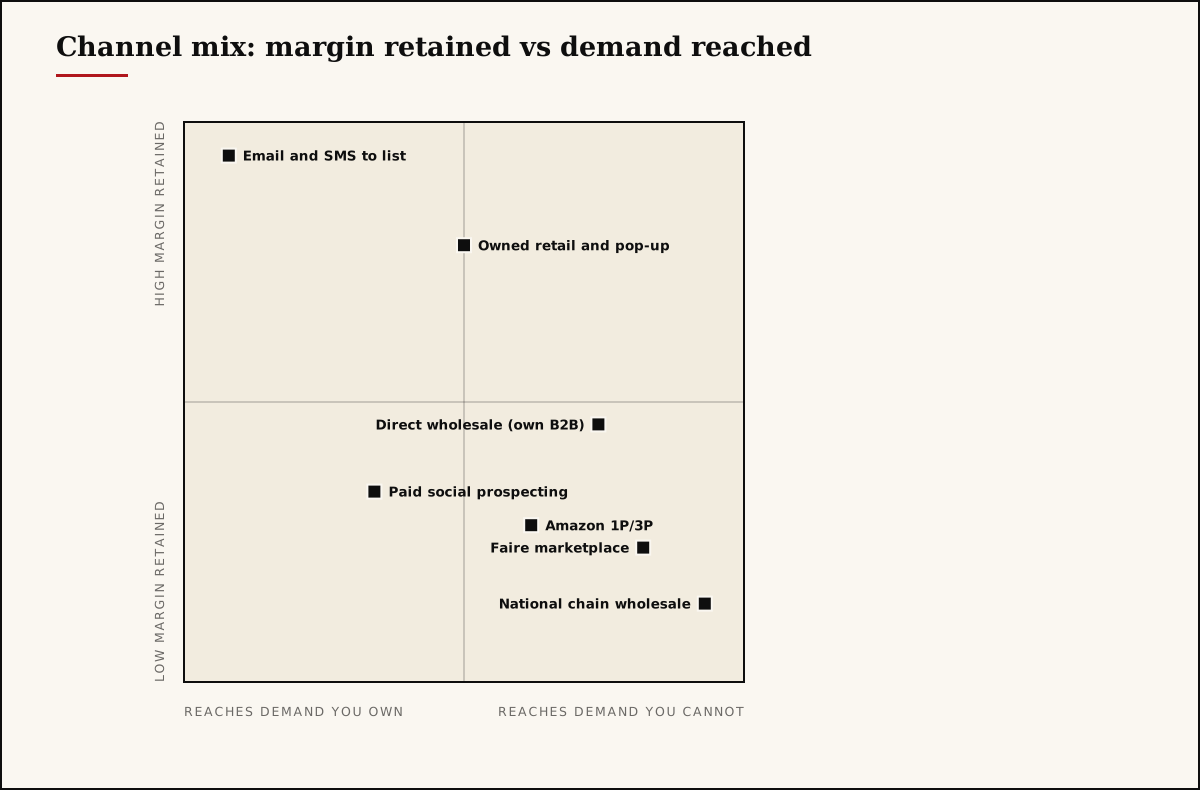
The vertical axis is contribution margin retained per dollar of revenue. The horizontal axis is how much of the demand is genuinely outside your existing reach. Email to your own list sits top-left: almost all margin, almost no new demand. National chain wholesale sits bottom-right: enormous new demand, very little margin left after the discount, freight, and deductions.
Paid social prospecting sits awkwardly in the middle-left, and that is the point. At $5M with a mature account, a large share of paid impressions is reaching people already inside your orbit. You are paying new-customer prices for existing-customer reach.
The comparison that actually matters
Do not compare gross margins. Compare contribution margin after every channel-specific cost, and then divide by the working capital each channel ties up.
| Channel | Typical revenue capture | Channel-specific costs | Cash cycle |
|---|---|---|---|
| DTC paid acquisition | 100% of retail | CAC, payment fees, shipping, returns | Instant, but spend is prepaid |
| Owned retail or pop-up | 100% of retail | Rent, staff, fixtures, shrink | Instant, inventory sits on floor |
| Direct wholesale | 40% to 60% of retail | Freight, samples, rep commission, terms | Net 30 to net 60 |
| Faire marketplace | 40% to 60% of retail, minus 15% | Commission, $10 new-customer fee, processing | Payout speed dependent |
| National chain wholesale | 40% to 50% of retail | EDI, chargebacks, co-op, routing compliance | Net 60 to net 90 |
Shopify's own pricing guide puts the convention plainly: keystone wholesale price is retail divided by two, with retailers adding 35% to 65% markup on resale. If your DTC contribution margin after CAC is already below 30%, wholesale at half of retail will not save you. It will just lose money faster with better volume.
On the chain side, deductions are a real and under-modelled cost. SPS Commerce reports that only 20% to 30% of retailer deductions are ever disputed by suppliers, and roughly 40% of disputed deductions are won back. Budget for the deduction, then budget for the person who fights it.
Tooling, and where each one is the wrong answer
| Tool | Price | Best for | Wrong choice when |
|---|---|---|---|
| Shopify B2B | Included on plans that support it, no extra fee | Companies, catalogs, volume pricing and payment terms on your existing store | You need retailer discovery, not order management |
| Faire | 15% commission, $10 new-customer fee, 1.9% to 3.5% processing, 0% on Faire Direct | Finding independent doors you could not reach | You are pushing accounts you already own through it |
| Brandboom | From $50/mo billed annually | Line sheets and order capture for a small rep-led wholesale book | You need full inventory and fulfilment orchestration |
| NuORDER by Lightspeed | Custom quote, not published | Multi-season apparel with complex assortment and rep workflows | You have under 50 accounts and no sales team |
| Cin7 Core | $349 to $1,199/mo | Multi-channel inventory truth across DTC, wholesale and retail | One channel and under a few hundred SKUs |
| Shopify POS Pro | $89/mo per location | Owned retail and pop-ups sharing one inventory and customer record | You are testing a weekend market and can use POS Lite |
| Triple Whale | $179 to $539/mo | Blended contribution reporting across paid channels | You need wholesale P&L, which it does not model |
Two notes. First, Faire charges 0% commission on Faire Direct orders you refer yourself. Brands routinely leave five figures on the table by letting existing accounts reorder through the marketplace. Migrate them.
Second, Shopify's B2B features handle companies, catalogs, volume pricing and payment terms natively, and POS Pro is $89 per location per month. The platform cost of adding a second and third channel is now trivial. The real cost is operational attention, which is the constraint people consistently under-price.
For the mechanics of standing wholesale up, see our wholesale channel launch guide and the Shopify B2B setup walkthrough. If marketplaces are on the table too, the Amazon versus DTC channel math covers that comparison.
The cash trap that kills good channel decisions
The margin case for wholesale is arguable. The cash case is where brands get hurt.
DTC is cash-positive on day one: the customer pays before you ship. Wholesale inverts that. You buy inventory, produce it, ship it, then wait 30 to 60 days for payment, sometimes longer if a deduction dispute is open. A brand adding $1M of annualised wholesale on net 60 needs roughly two months of that revenue sitting in receivables permanently, plus the inventory to support it.
That is not a reason to avoid wholesale. It is a reason to fund it deliberately, from a source that is not your ad budget. Brands that quietly cut paid spend to buy wholesale inventory get the worst of both: DTC revenue falls immediately, wholesale revenue arrives in 90 days, and the founder concludes wholesale does not work. Model it properly against your cash flow forecast before the first PO.
The signal that says "add a channel"
Stop using revenue thresholds. Use marginal efficiency decay.
Run this monthly. Take your paid spend in $25,000 or $50,000 bands and compute contribution margin per band, not the blended average. In a healthy account the top band still clears your contribution floor. In a saturated account it does not, and no amount of creative refresh moves it.
The trigger condition is all four of these at once:
- Marginal contribution on your top spend band has been below your floor for two consecutive test cycles.
- Creative and offer work has been tested in that window and did not restore it.
- Your gross margin at 50% of retail still leaves positive contribution after freight and commission.
- You can fund 60 to 90 days of receivables without reducing paid spend.
Fail any one of those and the answer is still paid, or product, or price. Not a new channel.
Our take
Most agencies will tell you to diversify channels because diversification sounds prudent. We think that framing is wrong and it produces bad decisions.
Diversification is not the goal. Channel expansion is a response to a specific, measurable condition: the marginal dollar in your best channel has stopped clearing your contribution floor and cannot be recovered with creative, offer or landing page work. Until that condition is true, adding a channel is a distraction that consumes your two scarcest resources, working capital and senior operator attention, and returns less than concentrating would.
That is the argument from mechanism. A channel earns its place by reaching demand your current channels cannot reach, at a contribution margin above your floor, without starving the channel that is already working. Three conditions, all required.
Where we disagree most sharply with conventional advice is on sequencing. The standard playbook says get DTC to scale first, then layer wholesale in as a maturity move. We think that is backwards for a large share of brands, particularly those with physical products under $60 that demo well in person. If your product needs to be touched, smelled or explained, you are paying Meta a premium to do badly what a shop assistant does for free. Those brands should be building wholesale at $2M, not waiting until paid efficiency has already collapsed at $8M and the decision is being made under pressure.
The second disagreement is about owned retail. Everyone treats it as the expensive, late-stage option. On a per-unit contribution basis it is the best channel most brands will ever have: you keep the full retail price and pay no commission and no CAC on walk-in traffic. What makes it dangerous is not margin, it is the conversion of variable costs into fixed ones. A three-month pop-up tests that with a fraction of the commitment, and Shopify POS Pro at $89 per location makes the infrastructure a rounding error. Very few $5M brands have run that test. Most should.
The third: do not let the wholesale team price against DTC. If your wholesale accounts undercut your own site, you have not added a channel, you have added a competitor with your logo on it. MAP policy and channel-specific assortment are not bureaucracy, they are the thing that keeps the DTC channel worth having.
What to do this week
- Rebuild your paid reporting by spend band, not blended, and identify the marginal contribution on your top band.
- Calculate true contribution margin for a hypothetical wholesale order at 50% of retail, including freight, samples, commission and a 2% deduction allowance.
- Pull every existing wholesale account currently ordering through Faire and move them to Faire Direct at 0% commission.
- Model 90 days of wholesale receivables against your cash position and confirm you can fund it without touching ad spend.
- Map your DTC customer density by postcode and identify the three metros where a pop-up or a cluster of independent doors would reach existing demand density.
If you want a second pair of eyes on which channel your next dollar belongs in, book a call and we will work through your contribution-by-band numbers with you. If you already know the answer and want the build, the custom quote page is the faster route.
Frequently asked questions
There is no revenue threshold. The signal is marginal efficiency. When your last incremental $50,000 of monthly paid spend returns materially less contribution than the average dollar before it, and creative and offer work has not restored it in two cycles, the marginal dollar has a better home elsewhere.
Some overlap is real, especially in dense metros where the same shopper sees the brand in a store and buys there instead. But wholesale mostly reaches people your ads never touched, and shelf presence usually lifts branded search. Track branded search volume and DTC revenue by postcode before and after doors open.
Compare contribution margin after all channel-specific costs, not gross margin. For DTC that means COGS, shipping, payment fees, returns and paid acquisition. For wholesale it means COGS, freight, commission or EDI costs, chargebacks, and the working capital cost of net terms.
For accounts Faire finds you, yes, because the alternative is trade shows and cold outreach at a higher effective cost per door. For accounts you already have, no. Faire charges 0% on Faire Direct orders you refer, so migrate existing accounts and pay commission only for discovery.
One person who owns demand planning across channels, one who owns the wholesale relationship and order flow, and an operations partner who can handle case-pack, labelling and routing requirements. Below that, the third channel degrades the first two.
Only if you already have a customer density map showing where your buyers cluster, and only after a pop-up has tested it. Owned retail keeps the most margin per unit of any channel but carries fixed rent and staffing, which converts a variable cost structure into a fixed one.
One-page resource
Get the Small Store Revenue Checklist.
The 12 things that actually move revenue on a store under $50K a month, in the order we'd fix them. Delivered to your inbox.